Relationships: Oxygen of Life

Staying home and watching nature documentaries on Netflix. This week a situation a shrimp found itself in opened for me a window for contemplation. When the tide pulls out, it leaves behind rockpools where creatures are trapped unable to return to the ocean. In one was the unfortunate shrimp. As night progressed, oxygen began to run low. The desperate shrimp climbs out of its natural habitat onto the rock to breathe. It risked drying up and dying but the tide returned in time.

We are all trapped in little rockpools today. Covid-19 have deposited us into one. Like the unfortunate shrimp, we too find ourselves trapped in a very unnatural habitat. Some are running low on the oxygen for our livelihood: income, money. Others are choked by the carbon dioxide of worries. But nations have begun easing lockdown measures. The tide is coming back in, soon, to take us back out into the ocean of life. What learning will we take with us from this rockpool?

When the pandemic first came, it arrived like a tidal wave. Fear overcame us. We faced our mortality. The invisible virus showed us that every piece of possession and every strand of power was powerless against it. On a global scale, the tiny unseen threatened superpower nations. This enemy could not be nuked. Instead it needed small, individual but collective acts. Suddenly, we all became equally important as individual persons, made equal by the human life in us. The virus flattened the curve of power and possession. If anything, it restored my dignity as a person to know that what I do, or not do, counts in the equation of life.

When the tide come back in to take me out, I want to take with me this lesson of relationships. Every person shares a common relationship living in this world. We live in a spiritual ecosystem. We recognized that the best way to fight the virus is for humanity to be one and act in the interest of each other. Underlying this is the creed of our spiritual ecosystem, “Love one another”. It is a curious fact that governments and organizations shun away from this word “love”.

Without love, there can be no true relationships. Without love, relationships exist to be plundered, where we only take and not give. Without love, the spiritual ecosystem suffers. This pandemic has shown that humanity need this relationship for the order of life not to break down. We saw and heard of many heroic examples of people giving generously, some to the point of losing their life for the sake of the other. When we turn a blind eye to love, the common relationship among us breaks, gradually snuffing out the oxygen of life.

“The Lord is the living stone, rejected by men but chosen by God and precious to him; set yourselves close to him so that you too, the holy priesthood that offers the spiritual sacrifices which Jesus Christ has made acceptable to God, may be living stones making a spiritual house.” (Second Reading)

When lockdowns are lifted, we will not immediately return to the same habitat as we knew it to be. Social cost will be high as we see that social distancing has perhaps been more lethal than the virus for some, especially the poorest and the marginalized.* There are many people out there, unemployed now, paying the high social bill of this fight. The faithful are the elected people full of the Holy Spirit appointed to give out food (First Reading). The faithful are called to be the living stones in the common relationship among people in this new equation of reality.

What we do as individuals may be small, but it counts. It is time to become the oxygen of life.

“I tell you most solemnly, whoever believes in me will perform the same works as I do myself, he will perform even greater works, because I am going to the Father.” (Gospel)

*The unequal cost of social distancing.
https://coronavirus.jhu.edu/from-our-experts/the-unequal-cost-of-social-distancing
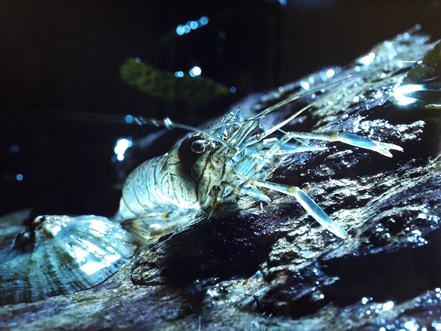
shrimp

From the Netflix documentary “Night on Earth” taken off my TV. 

5th Sunday of Easter
Fullness of Life

What does it mean that we “may have life and have it to the full”? (Gospel). The fullness of life is perhaps best comprehended from a lack of it. We would all have experienced periods in our life where we felt an emptiness in us, a void that prompted us to seek and search. Despite everything going well with family and work, we are bugged by a restlessness in us. Initially we cannot quite grasp it. But an inner voice gradually echoes louder in that emptiness, “What is the meaning and purpose of my life?”

The fullness of life is not a reward or an exchange. The fullness of life is simply a higher state of our being. It is attainable by every person of every belief. We can taste it fleetingly or we may dwell in it. This higher state of our being is marked by peace, joy, contentment and fulfilment. Contrast it with the prizes of possessions and status we crave for in worldly life. We do realize that each bag of gold, each platinum level of status will never satisfy. It has not helped in this pandemic.

There is an ongoing lesson about this fullness of life as the world battles Covid-19. Along the front line, every health care worker and every support staff draw from deep within their ‘self’ to give their all to save lives, even at the risk of their own. Ask anyone of them and its guaranteed that they are at peace with a sense of fulfilment. They have gone to give their life so that others will have theirs to the full. These people have experienced what the fullness of life is. In what they have given, their life is holy.

“He was bearing our faults in his own body on the cross, so that we might die to our faults and live for holiness.” (Second Reading)

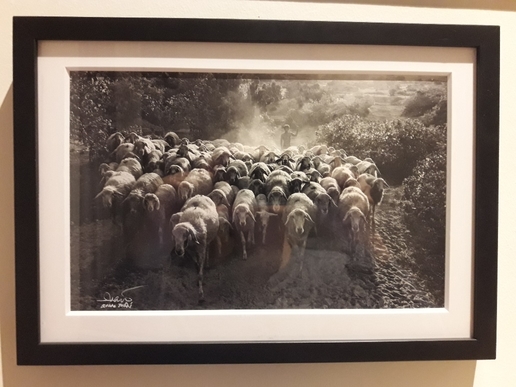
Most weeks I write inspired by this photo in front of me. This picture is today’s Gospel passage. “The sheep follow because they know his voice.” The Good Shepherd is unseen, “he goes ahead of them”, but the sheep are being led, following with the help of a shepherd faintly seen in the light of the sun in the background. In this whole scene I see the way to a higher state of being. It begins with humility, a surrender of self, to look upon ourselves as sheep. But mistake it not, striving to be truly humble is a lot tougher than chasing for gold and platinum.

The feeling that something is missing in my life can only be satisfied when we find the meaning of our life. An emptiness in life cannot be filled with possessions. The shepherd faintly seen in the photo is helping the Good Shepherd tend to his flock. He is not guarding possessions but is the helping hand of the Good Shepherd to look for the lost, to tend to the sick, to guide them through valleys of darkness, to comfort the weary, to lead them to green pastures, and involved in the daily life of the flock. He puts himself in danger for the sheep and is life-giving. His life is in holiness. He is a disciple.

A disciple is self-giving, always putting others first. A disciple gets involved in the life of others to share the fullness of life. This is a life where meaning and fulfilment are found.

In humility we will also recognise that throughout the journey of life our own actions have a consequent effect on others. Often, they cause harm. In humility we recognise that we are both shepherd and sheep, dependent on the goodness of one another. Helpful and helpless. Covid-19 has shown us this.

Covid-19 has also perhaps shown how lost we are. The underlying principle for the fastest way out of this pandemic is to truly love one another. Every measure to contain the virus, every step in our exit strategy is dependent on this principle. But few governments who lead us the way have managed to utter this word, “love”. Perhaps it no longer fit into the image of modern man. But love and holiness are a higher state of existence.

As we get our first haircut and start to eat out at a distance, we are running out of time to decide on our own exit strategy for our spiritual self. We can remain incognito and wait out these few weeks for life to return to what it was but where has that led us to? Or we can use this time to listen to that inner voice and map out our own exit strategy to move into this higher state of being and share in the fullness of life. What am I seeking? It is only in the fullness of life where our restlessness can be satisfied, where emptiness is full.

Fullness of Life

A photo I bought in Hanoi. Though it is signed I cannot make out the photographer’s name. “The Lord is my Shepherd, there is nothing I shall want”.

4th Sunday of Easter

Where are you going?

The tide of time can carry us far, our life can be floating directionless on its constant current. Many things happen to us on our journey through life. Some our own making but a large part consequent of people and events around us. This pandemic has shown us that. We can bob up and down like a piece of debris as we wait for this pandemic to make its way through the passage of time. But where will it leave us?

The tide is now turbulent. “We live in extraordinary times!”, an exclamation of a priest from where I am as he opens his homily each Sunday, appreciating the tremendous effect this virus is having on our daily life then expounding on the wisdom that the love of God accompanies us on this difficult journey. There is a silent wisdom out there. We must tune into it for direction. You and I are like the two disciples on the journey to Emmaus.

Life has changed for all of us. For many the change has been drastic and permanent. We have lost jobs and even loved ones. Rainy days are here. When, and if, this virus goes away, the world may not give us our jobs back. Will we allow this situation to take us randomly where it will and perhaps deposit us into a well of worries? The control stick is in our inner self. We must try to reach it to find that silent wisdom.

This is Easter. We must not see this as an extended Lent. Because if we do, we shut our senses off to the presence of the Risen Christ who is now walking with us, stride for stride, on this challenging journey. It is precisely because of moments like this that He went through Lent to rise and be for us this special presence. An extended Lent is a longing to be in the past or a faithless worry of the future. Easter is here and now. God’s timing has not gone awry.

Today’s contemplation on the Journey to Emmaus cannot come at a better time. In this itself, it shows God to be active in our life. We must open our eyes to see. A friend troubled by these extraordinary times confessed, “I too do not want to let this crisis go to ‘waste’. It would be such a shame to come out of the crisis as the same person I was going into it.” To transform, we embark on this journey to Emmaus to ‘encounter’ the Risen Christ.

Small beginnings lead to great transformation. Seemingly small things change us in big ways. Our smart phone is a good illustrative tool. If we observe ourselves say on a pilgrimage, we cannot resist the temptation of recording what is immediately happening before us. In so doing we have recorded the present into our past or consigned it into a digital future. We miss the richness of a God experience by not being present in it, in the here and now.

God is always acting in the present. He is available for us each moment. Be still and know I am near. The power of now.

Contemplating our life story juxtaposed with the journey to Emmaus can be a powerfully rich spiritual experience. It is a faith booster during this time of the virus. Every one of us have passed a few milestones marking life transforming events in our personal life. Dwell especially on challenging events in our past: illness, broken relationships, job loss, grief. At the time of those happenings we might have been angry with the Risen Christ and then forgotten about him. Trace our life journey from those episodes. Many opened new doors for us further down the road. Looking back lead us to an understanding of why certain things happened, (and thankfully they did). We will also find healing. Then we can say, “Did not my heart burn within me as he talked to me about my journey and explained my history to me?”

The Risen Christ has silently walked with us throughout our personal history, picking us up from our falls, clearing the way ahead, diverting us from the paths of danger and giving us peace in turbulence.

My same friend quoted from the poem, Footprints in the Sand, depicting the author’s life journey where there were two pairs of footprints, one belonging to himself and the other to the Risen Christ. “But I noticed that during the saddest and most troublesome times of my life, there was only one set of footprints. I don’t understand why, when I needed you the most, you would leave me.” He whispered, “My precious child, I love you and will never leave you. Never, ever, during your trials and tests. When you saw only one set of footprints, it was then that I carried you.”

This is the silent wisdom who awaits us. Growing in faith, evangelising oneself, requires this encounter with the Risen Christ. To quote from Thursday’s meditation from Word Among Us, faith grows into this new dimension only when “evangelization is a work of human encounter, not one of logical argumentation”.

So, we must stop bobbling in time, not knowing where we are going. Seize that control in your inner self. Walk to your Emmaus today by contemplating the events in your life story. Try to join the milestones, you will find that they link in an intricate way. As many challenges there were, there were also many unexpected twists and moments of gratitude. Who could have been walking beside you? This is Easter. It is time to ask, “Where do I want to go?”

“Remember, the ransom that was paid to free you from the useless way of life your ancestors handed down was not paid in anything corruptible, neither in silver nor gold, but in the precious blood of a lamb without spot or stain, namely Christ. Through him you now have faith in God, who raised him from the dead and gave him glory for that very reason – so that you would have faith and hope in God.” (Second Reading)

emmaus lea

“Where are you going? Where do I want to go?”

3rd Sunday of Easter

Living in Doubt

These past 8 days had been the Octave of Easter. We were celebrating the solemnity of Easter every day, but were we? “Rejoice!” is the Easter shout but maybe not for many as we remain plagued by doubt because of the pandemic. 8 days as well, but of doubt, plagued Thomas. He was told of the appearance of the Risen Christ. He could not believe because his faith had not yet entered this new dimension until he had a personal encounter with the Risen Christ 8 days later.

When I was younger in my faith, I used to snigger at Doubting Thomas. I had enough knowledge, was prayerful and faithful to Sunday mass. I always thought this passage was a plain vanilla; just “do not doubt”. Until trials entered my adult life, though I was not anywhere near gold being tested by fire. I just could not connect the happenings of my daily life to my belief. My faith needed to enter a new dimension to be convinced, fashioned by personal encounters with the Risen Christ.

Which Thomas are you, the first or the second? We cannot see this virus but can see its dangerous effect. Have we surrendered to doubt and crippled ourselves with anxieties so much so that “the Risen Christ” is a teaching but not a lived experience? This is not so easy. Everyone is having a tough time. People have lost loved ones. Many lost jobs becoming financially disabled to support family. Pain is real.

This pandemic has shown our world to be deeply wounded. All peoples have never ever been more united sharing one common fight. To beat the virus, the world must act as one. Amazingly the action of each individual person is crucial. Looking deeply, it brings out what Christ has always emphasised. “You” as an individual are precious; “I have called YOU each by name”. You and I make up the one body of humanity. But our body has wounds, visible by our individual responses to the pandemic. We have perhaps shown the lack of conviction in our faith principle to love one another. Rather, from powerful world leaders to you and me, we have become somewhat self-loving.

Staying home, social distancing and wearing a mask are acts asked of an individual. Little acts that seem to greatly affect our self-opinionated selves. We look at the letters of these rules to find a way round them. If such small sacrifices are difficult, how much more difficult will it be to love the other person, a stranger, and harder, an enemy? We should not question the rules that govern us but the principles we have that shape our life. *

We salute people in the medical profession. In them you clearly see their life principles, a life they are willing to put at stake. They are not hiding behind rules or personal rights. In their training, one principle dripped into them: love life, save lives. Do we doubt our faith principle to love one another?

Our world including every person is truly the Body of Christ. As disciples we are called into action now to “see the holes that the nails made in his hands and put my finger into the holes they made” and “to put my hand into his side”. We are called into mission today to make compassion and hope tangible to the downtrodden. We are to put our hands into their wounds. We are called to be Easter people to make the Risen Christ visible. We are the people through whom his divine mercy can be expressed. In so doing, we remove the doubt of Thomas in everyone.

We have been educated in our belief, but the test is in the application We are rich in our knowledge, but knowledge is only a tool that shows us how to live by principles. Our prayers, our Sunday mass, our nightly rosaries and devotions, and our weekly bible class prepares us for a season like this. It is a season to rise and act. We have been taught how to be a disciple. This is the season to be one.

It is the season of the Acts of the Apostles. It is a season to build communities of believers to pronounce love and embrace hope. It is a season to bring faith onto a new level where joy can co-exist with suffering. It is a season to see through our doubts, the season to realise that our life’s eternal goal, that which truly matters, is beyond the reach of the virus. It is the season to enter the new dimension of our faith to encounter and experience the Risen Christ in our personal life.

We must first enter our personal desert of doubt and be alone with the Risen Christ. We can perhaps enter this desert if we allow ourselves to contemplate the small possibility that ‘I’ may not survive this virus. ‘I’ may die. What then becomes important? ‘I’ have so far placed confidence in humanity, how much confidence have ‘I’ placed in the Risen Christ?

Let us emerge from the tomb of doubt. This cloud of doubt has been necessary to release us from the grip of every worldly comfort we cling to for an answer to this pandemic. This cloud has left us alone in our desert to come face to face with Christ Risen. The reasons for doubt are because we placed our beliefs in worldly things that have fallen short of conviction. It is time to be the second Thomas and put our finger into his wound.

*Principles for a pandemic. Sr Joan Chittister. National Catholic Reporter. See ncronline.org/news/opinion/where i stand/principles

Risen Christ 2020

“Through your faith, God’s power will guard you until the salvation which has been prepared is revealed at the end of time. This is a cause of great joy for you, even though you may for a short time have to bear being plagued by all sorts of trials; so that, when Jesus Christ is revealed, your faith will have been tested and proved like gold – only it is more precious than gold, which is corruptible even though it bears testing by fire – and then you will have praise and glory and honour”

2nd Sunday of Easter

To see something in nothing

Can we see something in nothing? This pandemic has pulled the shutters down on our future. Everyday life as we know it to be has been taken away. Stay home, into your tomb. Life has emptied out for most of us. We wait in an emptiness. Blinded by an uncertain future, we are unable to see richness in this emptiness. But in this nothingness, we subconsciously cling to hope. There is yet something in emptiness.

“Then the other disciple also went in, the one who had arrived at the tomb first, and he saw and believed”. (The Gospel of Easter Sunday). John entered the empty tomb. He saw something in nothing. He saw Christ, risen. He saw sense in everything he had learned. He saw his fear of his uncertain future evaporate. He saw his new faith born in that emptiness. John’s life transformed. There is something very powerful in this nothingness for all of us.

This pandemic has forced us to sit in this ‘here and now’. There is a clear and present danger. As each day passes with the virus spreading, we feel more vulnerable. This vulnerability is beginning to ask some tough questions. The first, slightly self-serving, is “What do I want from life?” There may not be a satisfying answer before we go to the next, “What is the meaning of life?” This is now a dialogue with our spiritual self.

This time is an opportunity for contemplation, when life is stuck in the present. This is a time for some soul-searching questions. What is the source of this hope we are sub-consciously clinging on to? We must enter our personal tomb, into the still and quiet of our inner self to listen to what God is saying to ‘me’? There must be something out from the desolation of this virus because “Emmanuel – God-with-us – is a promise that God will be with us every moment. In this emptiness, we are not alone as the Risen Christ walks with us.

We are the faithful. We are called to be light to this darkened world. Pope Francis has a wish for the Church to be “field hospitals”. Our prayerful life in the past was to prepare us for today. We must rise above our personal sufferings to evangelise. We must become the handle of hope, the face of faith in the shattered, fear laden lives of so many people affected, who have suddenly found themselves in emptiness. In their emptiness, they must see us through evangelisation. We must make God real in the reality of their struggles. God need us today to be his vessels of love and compassion. He has no one else to call upon.

Today, we the faithful are in anguish like everyone else. But we have been graced by the sacraments, the strength to rise above self is within us. Jesus was suffering too the night before he died. He responded to his anguish by washing the feet of his disciples. His last chapter on love was “serve others” before he closed it by giving his life to them, us. Despite his suffering, he served.

We are back to the time of Jesus. Many then waited for a Messiah. They expected a king with power to conquer all before him and restore the land to riches. Instead they had a king who hung limply and died on a cross. Today as evangelizers, we will encounter many people plagued by doubt, “If God is real, why does he allow this pandemic that cause so much suffering?”

This is not a judgement of doubters or non-believers but a recognition that every human person is at a different stop on their earthly journey. They cannot yet see something in nothing. Faith has not yet materialised for them. As the faithful, we must help them see as we are called to bring the kingdom of God into their lives.

We must try to make sense of suffering. Can suffering and joy co-exist? There is a reason why the Church emphasise that the Easter Triduum is one complete celebration; to illustrate perhaps there should not be a greeting, “Blessed Good Friday” because it misses the meaning of the Easter Triduum taken as one.

Some people relate more to Good Friday than Easter Sunday, evident in those who come to Church once a year, they come on Good Friday. It shows we are stuck at the foot of the cross in suffering without realising there is already a resurrection. There IS a resurrection after crucifixion, and joy will follow suffering if we embrace this faith in its entirety.

This IS the Good News. We are meant to live as Easter people. “It means we live as a people, all parts of Christ’s Body working together toward a single purpose: love*.”

There is something in the nothingness created by this virus. There is something yet in our own empty tomb. Let us roll back our stone of doubt, unbelief or disbelief, self-anxiety and fear, pride and unforgiveness, anger with God and bitterness, to reconcile, trust and rise in the Risen Christ waiting in our tombs. He commissioned us his army of love, to go and raise the shutters of darkness and let in rays of hope for the many people despaired by the pandemic.

For the Resurrection is Truth. Becoming an Easter people embraces the fullness of Life. In so doing, we empty ourselves of ‘self’ and find that answer to the meaning of life.

Happy Easter!

*Quote from Vinita Hampton Wright, Live as Easter People. IgnatianSpirituality.com

“This man God raised on the third day and granted that he be visible, not to all the people, but to us, the witnesses chosen by God in advance, who ate and drank with him after he rose from the dead. He commissioned us to preach to the people and testify that he is the one appointed by God as judge of the living and the dead. To him all the prophets bear witness, that everyone who believes in him will receive forgiveness of sins through his name.” (First Reading)

Unseen

He commissioned us his army of love, to go and raise the shutters of darkness and let in rays of hope for the many people despaired by the pandemic.

Easter Sunday 2020

Will we rise from this?

For many of us it is a question of time before humanity develop a vaccine that will overcome this virus. Few who read this will dwell on the possibility of death. Yet thousands have died, their prayers seemingly in vain. Health is a very fine line; on one side, confidence and on the other, desperation. Confidence arises out of faith. Either faith from our trust in medical science or from our trust in God behind the work of medical science.

What if there is no vaccine? Will desperation shift us towards God?

Today we enter Holy Week, perhaps at a most appropriate time. We come face to face with the suffering of Christ. We remember his painful prayer on the rock of agony the night before he died, “Father, take this cup away from me”. As one humanity we have been praying for a vaccine so that this cup of suffering from the virus will be taken away from us.

For many of us, these are indeed desperate times. As this pandemic form a cross of suffering, we are stripped of our life as we know it and scourged by fear and worry. “My God, my God, why have you forsaken me?” Every year Holy Week comes around to remind us to focus on heavenly things. This year it comes at a time when every earthly thing in the form of wealth, status and power that we cling dearly to are vulnerable against this virus. Today in front of each of us is a personal cross.

Take up your cross and follow me”.

We are called into constant repentance, not to sit in sack cloths beating ourselves with guilt but to continue to refine our life to be a better person, to be one who will rise into our ultimate destination of heavenly glory. Repentance has never been about judgement. It has always been about God’s desire, out of love, for us to be risen. Holy Week tells us that the cross triumphs over inevitable human suffering. But amidst this pandemic, maybe we are not quite ready to hear that.

Many are suffering. Many lost their jobs or are about to lose them. These are very difficult times and we must be sensitive to our human state. Worry, fear and anger with God are natural responses because we are human mortals. Worry is like falling into a quicksand pit. It will consume us if we don’t reach out and grab something that can save us. The only thing is front of us today is our personal cross. There is no choice but to intentionally take it.

We are never ready. We are being human. We contemplate this week about Christ himself, praying on that rock for the cup to be taken away, that being human he never wanted his suffering and dying on the cross. But he emptied himself. He de-focused from ‘self’ and thought about the ‘other’. And did the will of God. Love others. This virus has put us on our own personal rock of agony.

When we intentionally take up our cross, we make ourselves available for the other person. There are enough people around us suffering in various ways today. We must rise above our own and go out to help others whether it is to provide material needs or to provide our time to offer consolation. People in medical care are our heroes today. They discounted their own life and that of their family to give life to others. Taking up our cross embraces the spirit of compassion that is born out of it. This spirit is life-giving and ensures that we will rise from our suffering.

This is how Christ invites us to unite with his suffering. When we help others while suffering ourselves, we make the voice of Christ authentic and louder. When we intentionally take up our cross, we embark on this mission to bring the love of God into the realities of others’ lives. We become authentic disciples. In the acts of being disciples we open ourselves to being healed and detached from our worries. In taking up our cross, we eventually find peace and rise above our own suffering.

We enter Holy Week. The peace from being lockdown is surreal. We have a lot of idle energy. ‘Idle’ because this energy would otherwise be used for our work and other earthly schedules. But everything is standing still. It gives us the opportunity to contemplate. In this quiet stillness we come face to face with our personal cross.

If there is no vaccine to get us out of this virus, this way of the cross is our only way out. We may channel this energy to take up our cross. If we take it, come what may, this Easter we will together rise to new life.

Adam 2

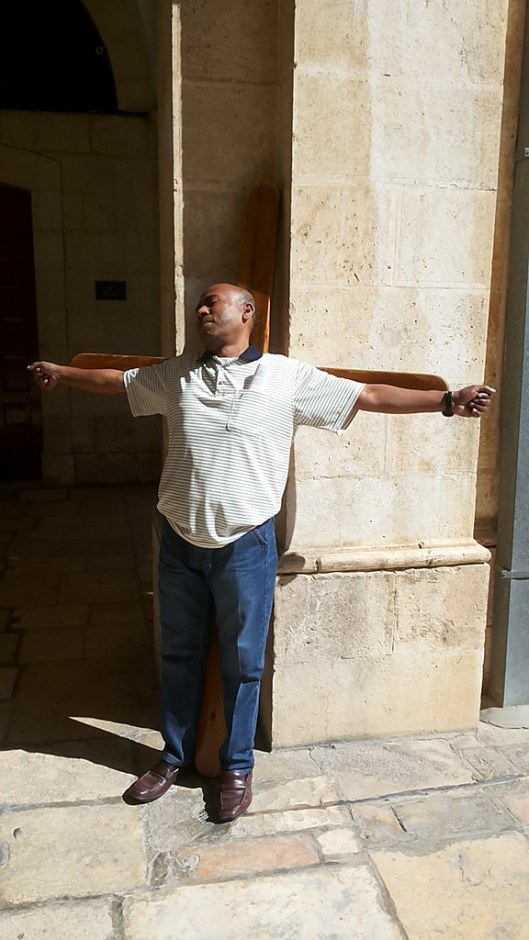
Courtesy of my friend Adam whose life journey had been one of challenges until he intentionally took up his cross. Challenges continue to exist but he has found peace. 

Palm Sunday, start of Holy Week

God, where are you?

God, where are you? This pandemic is moving “like a bullet train” from one panic station to another. We struggle to de-focus from it, we cannot think about anything else. Every new day bring more grim news. We are entombed in uncertainty, fear rules in this darkness. We are able, in an uncanny way, to postpone all our worries from our derailed life. Mainly because this virus threatens our life here and now, dwarfing the future.

We need to bring God into focus. Reflecting on the day’s Gospel message without relating it to this virus situation render it so irrelevant. Today, more than any other day in living memory, we need the Gospel to come alive immediately. We need the presence of God to walk in our midst. We need to see and feel Him in this here and now. But we must first get off the bullet train of panic to be present.

God is not distant, somewhere in this vast universe, a universe just made a lot smaller by this virus. God is not peeping through the cloud waiting for more prayers to rise to him. He has come down to be in humanity. He dwells in each one of us. We must look inside to find him.

God is not punishing the world with a plague, but we live in consequent times. This virus, like many other crises, is a consequence of our lifestyle. Its rapid spread is a result of Man not coming and working together, a consequence of the different ideologies and lifestyles we have chosen for ourselves over a long period of time. Because at the very beginning, God made us for one another but gave us the freedom of choice with a promise that He will be with us till the end of time.

We can see him in the force that is ushering our world to be united, this cry that we can only win if we fight this together as one humanity. We see him in the people in the front line, visible like light in darkness in doctors and medical care personnel giving their life for the sake of the patient. We see him in the windows that open and hear him in the songs and claps from the balconies of people appreciating these others in medical care. Be assured that when someone dies alone, He is present.

This war as one humanity involves every single one of us. Everyone is a soldier, no exceptions. We have our role to play in physical distancing, failing to do so may be consequential in somebody dying. Every little act counts to the point of a cough. Today, “to each his own” will lead to ruin. It is time to use our freedom of choice for the other. It is the only lifestyle we must adopt, and God is showing us the way.

No lockdowns will work if we do not exercise our freedom of choice to be holy. Holiness is to concede self-importance to be humble and act for the greater good of the other, giving up every inch of our personal rights. Obedience is this fruit of humility which the world is looking for. It calls for us to practice “personal lockdowns” and take responsibility, going out only when necessary. Be mindful that our small acts are carried by this virus at bullet train speed. Small acts can grow into a catastrophe.

Today, the world has finally recognized ‘you’ as an individual. The world has put a value on your personal contribution. Regardless of your status, wealth or power, ‘you’ make an equal contribution. ‘You’ are no more a unit or a statistic. You are called by name.

I began Lent in the pursuit of holiness through simple acts of self-denial. I vowed to walk instead of getting into a taxi. Today taxi lines are long, drivers wait a long time for a fare, their livelihood severely affected. To be holy now for me is to take the taxi, to offer words of consolation and give the driver a little more in fare.

God dwells in you and me. Very often he wants to use you and me to answer the prayer of the other person. The most prominent way his presence becomes visible is through people. God is found in the acts for the other person. Holiness is to be for the other person. We are all transmitters of love and mercy in everyday acts.

This is a lifestyle that God want us to use our freedom of choice to adopt. He is not an authoritarian God who says, “My way, or else” but one who knows the way out of the tomb of darkness we have found ourselves in consequent of our unholy choices. We are called to light up this darkness with our small acts to help God show the way. Follow the light.

This is where God is found, in you and me.

“A man can walk in the daytime without stumbling because he has the light of this world to see by; but if he walks at night he stumbles, because there is no light to guide him”. (From the Gospel of this the 5th Sunday of Lent)

Follow the Light

“Follow the light” – Dedicated to Chia Kim Yong.

Unmasking who we truly are

As we enter our small room to self-isolate, we enter the big hall of silence. Silence speaks, but we must want to listen. Life as we have been used to, have come to a halt. Our schedules have decluttered. Workplace targets are suddenly no longer important. We have entered a waiting zone. We can bring the outside in and shatter the silence with fear, or we can bring our inside out to embrace this silence and find out who we truly are. Precious time is now in our hands. Contemplate life by listening to the sound of silence.

People of every difference have never been more united in focus and fight, this “enemy against humanity”. There are a few things this virus does not know. It does not know the differences that seem to separate people, our religion or beliefs, the color of our skin, nationalities or borders, our status, rich or poor, our gender or age. It does not know what discrimination is. What it seems wise to is that all humans are equal, and all humanity is one. This virus has so far treated us as such.

Fear. Underlying this fear is our fight to live. Behind the silence, this gift of life. We are cherishing life as never before. Fear is the barometric value we place on the pricelessness of life. Fear is the natural, human response when life is threatened. It is our first response. Fear expresses itself in extreme behavior. Behind the person who hoard, or stockpile is still a person much capable of compassion. Because it is for compassion and from compassion that you and I were created. Who am I? Who have I become? Who do I want to be? But who should I be when this life is returned to me?

Who have we become?

For a generation or more, we have unknowingly been in the process of self-isolation. Our view of this life, which today we are fighting for, our attitudes and behavior had gradually evolved into one of self-interest, self above others, as we took part in the march towards ‘personal rights’. We have widened the chasm in life, between rich and poor, the powerful and the weak, discriminating between cultures along racial lines. On the banks of this chasm, we rule that we must first take care of ‘self’.

Governments and cultures had different first responses to fight the virus. The East was largely branded as authoritarian states imposing draconian lockdown measures on an obedient population who did not feel individually infringed. People just went inside their homes; few were shouting for “personal rights”. In the silence, the “obedient” understood a little bit more about the order of life.

Humanity, regardless from East or West, is evolving along this chosen path of life. Government authority has shrunk into individual and personal authority as humanity embrace the right to “personal rights”. Where large borders were once drawn to take care of the country, borders are now re-drawn to take care of self. This new ‘personal authority’ blind-siding us to see things for the greater good of all. This quest for self-authority leads to the individual to being self-isolated from the community of life, asymptomatic of a virus that attacks our spiritual health.

We are trying desperately to catch up on lessons from life as this virus rapidly move to lockdown countries, shutting the world down. We learn that humanity is one and every human need one other. No man survives self-isolation for being self-centered. Yet self-centeredness is a spiritual virus that has been with humanity a long time. In this silence, we must come to this awareness.

The vaccine for this spiritual virus is humility and self-denial, to recognize that we must put the common good ahead of self. It is not so complex if we find a way to unconditionally love the other person. It starts from our inside, to bring to the outside who we truly are. Our created image was made in the likeness of good, as a vessel of love. We see that proven in the innocence of a child. But the paths we chose for ourselves in life had corrupted that innocence. In this silence, vice-gripped by the virus, we have no where to go but to go inside our self and contemplate on who we truly are.

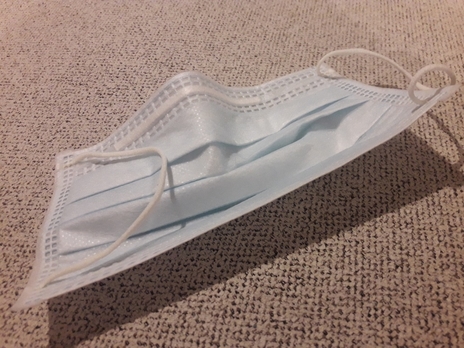
To self-deny is to concede an opinion which is simple and tough at the same time. Wearing, or not wearing a mask can create an argument. The immediate suffering does not come from the virus but from not winning the argument. Self-denial is to wear a mask if not wearing one causes a scandal. To be obedient is also to self-deny.

Humility and self-denial close the wide chasm in humanity. It starts with every human regardless of power and status. People in high positions of leadership playing the blame game, calling names and politicizing the virus cause an embarrassment to our true inner self that make even quarrelling little children on a playground blush. But this is a human weakness, we all suffer this in varying degrees.

Humanity has come a long way, moving and progressing in many directions. We attempted to control nature, to control Creation. The virus is not nature hitting back, nor the Creator punishing. It has come about as a result of a series on consequences of the paths we have chosen in life. And it will get worse if we do not come together as one, urgently. When we were created, we were told that the only path we choose through life is the path that says, “Love God, love others”. Humility allows us to concede that yes, there is a God after all.

Self-denial is to give away all my anxieties and fear. It is to deny myself to worry and put trust in God for this outcome. It is time to make the journey deep into our hidden self to discover who we truly are. In that self-isolation we might just be unmasked of who we have become. And to know that we are not alone.

Who do I want to be when this virus returns my life back to me?

mask

A contemplative passage through a very difficult Lent.
Grateful thanks to Fr John Murray for pointing the way, “Contemplate!”

Religion fulfilled

Religion used to play a more prominent role in everyday life, for a person as an individual and for people as community. As we rode on the train of secularism, many new tracks appeared before us. Technological progress at high speed, coupled with adequate comfort from materialism, meant that many switched tracks leaving behind the heavier cargo of religion.

As religion chugged along the old track, to the eyes of some detractors it developed into religiosity, a compulsive and repetitive set of rituals. Most religions have ethics shaped from the wisdom of the religion to guide us to live daily life. Guides are found in laws and commandments, but we need wisdom to give flesh and spirit to these laws.

“Jesus said to his disciples: ‘Do not imagine that I have come to abolish the Law or the Prophets. I have come not to abolish but to fulfil them. I tell you solemnly, till heaven and earth disappear, not one dot, not one little stroke, shall disappear from the Law until its purpose is achieved.” (Today’s Gospel)

The purpose is for each person to find the true meaning of life. Without this meaning, our life cannot be fulfilled. Every teaching of the Church leads us into this fulfilment. Every ritual and commandment we religiously follow must evolved into actions in daily life encapsulated in these four words, “Love God, love others”. Religion without action is philosophy without wisdom. Without the virtue of love, religion cannot be fulfilled.

“For I tell you, if your virtue goes no deeper than that of the scribes and Pharisees, you will never get into the kingdom of heaven.” People can be religious without fulfilling the religion.

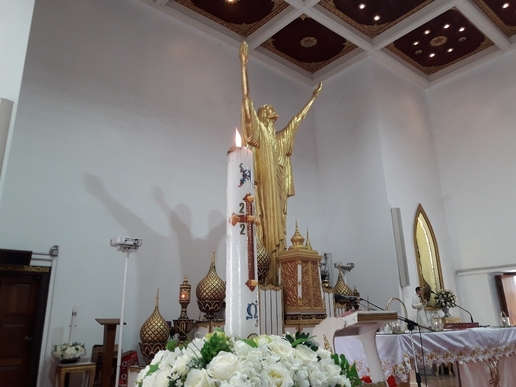
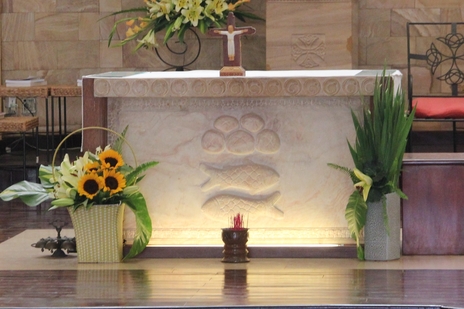
I was at mass in Phnom Penh. I am familiar with rituals with candles. I am not so with the use of joss sticks. This is the inculturation of our Catholic faith. The ritual is visibly different, but it needs to be in order to speak the same language and drive the same wisdom for people who are different everywhere. The fulfilment of life for every person regardless of nationality or culture is the same, one constant: Love God, love others. Piety in worship must be transformed into holiness in life.

Religion can get back onto the train of modern lifestyles. But we must adapt as the world changes and we must hurry as the pace gathers. Gone are those days when religion is a knock on the door with the knocker asking, “Do you know Jesus?”. Today we won’t even open the door to strangers. Religion will only be fulfilled when it knocks on the door of the heart. A person can turn his back on religion, but no person can turn away from true love freely given.

We all have a purpose in life, but each discovering through a unique journey. At the junctions of choice, we remember today’s first reading, “If you wish, you can keep the commandments, to behave faithfully is within your power. He has set fire and water before you; put out your hand to whichever you prefer. Man has life and death before him; whichever a man likes better will be given him.”

And wisdom shares that true love is always forgiving, always waiting.

PhnomPenh

6th Sunday in Ordinary Time

Salted

I like my steaks grilled medium rare; each piece eaten with only a pinch of salt. I do not prefer sauces. There are now flavoured salts, some of which are very good. Just that pinch of salt for me add so much more to the taste. Salt. In Bangkok I enjoy the Thai trilogy of taste: sweet, sour and spicy. But without the little salt this trilogy cannot be what it is.

“You are the salt of the earth. But if salt becomes tasteless, what can make it salty again? It is good for nothing and can only be thrown out to be trampled underfoot by men.” (Today’s Gospel)

We are called to be the salt of the earth, invited to make a difference to life. Not only our own but to those around us. When we start to hoard essentials because of the virus we must realize that it is only due to our affluence that we can afford to. People who live from hand-to-mouth can ration to keep aside some but cannot hoard. An empty shelf will greet them when they can next afford. The ‘salt’ question will come when the doorbell rings and a neighbor ask if we can spare some essentials?

“Share your bread with the hungry, and shelter the homeless poor, clothe the man you see to be naked and do not turn from your own kin.” (First Reading)

To become salt of the earth is not confined only to providing material needs. Salt is an underlying essential. People’s lives are also sweet, sour and spicy; our life experiences sweetened with joy, soured by bitterness or spiced by excitement. The little bit of salt in these flavours of life ensures that we keep in touch with our spiritual self, this soul created in the likeness of our Creator, whose identity is one of true love.

To become salt of the earth, we must be mindful of our natural capacity to love. In the context of today’s world, salt comes in different flavours. They are meant to surface this love in our life, to take the lamp out from under the tub.

A pinch of self-denial can reawaken our conscience. Our conscience is a compass towards true love. This pinch of self-denial first reminds us of our neighbour. Then it flavours our words and actions to allow this light of Christ to shine through the life we live.

The life we live can sometimes be quite tough. The pain from the challenges can blind us to deny this love of our Creator. Gratitude is a flavored salt. Life has delivered me a few bitter experiences. Wallowing in self-pity I preferred to immerse myself in bitterness dreaming of revenge. I was then reminded of gratitude, of the many blessings despite my challenges. A dash of gratitude stirred into bitterness can lead to a remarkable recovery of our true spiritual self.

Forgiveness is another flavored salt. Forgiving goes against the grain of our instinctive nature. The salt of forgiveness begins to impact our life when we do the unexpected of praying for those who persecute us in our daily life. We pray to take away our hatred and through forgiveness become a brighter light to the world.

Salt make words of love come alive. Salt is the grace to do good, and to make a difference. Salt is abundant in us, worthless if not used. Salt is the fuel to power the Holy Spirit to transform our philosophy of religion into little acts of love for all of us to experience and be convinced and make tangible the love of our Creator in our life. And all of us need only a pinch of it.

St Paul, “Far from relying on any power of my own, I came among you in great ‘fear and trembling’ and in my speeches and the sermons that I gave, there were none of the arguments that belong to philosophy; only a demonstration of the power of the Spirit. And I did this so that your faith should not depend on human philosophy but on the power of God.” (Second Reading)

steak

5th Sunday in Ordinary Time