Walk on Trust

We are troubled people. Even when we don’t go looking for trouble, it can come to us. We will realise by now that we cannot have control on everything happening to us. Our life can change as a consequent of another person’s action. Our path in life is often littered with such challenges. 

Two disciples were walking the path to Emmaus talking about events that had happened. When the Risen Christ walked beside them, they did not recognise him. Instead they expressed incredulity that he did not hear about the things that were happening. 

Of course for the two disciples it was about the crucifixion and their walk on the path of enlightenment about the resurrection. We as believers today have the benefit of faith to help us walk the path of our challenges. 

Some of us would have experienced events that had large-scale implications and affected a larger number of people in challenging ways. It can come from a government policy or changes at work where we have little choice but to accept. Worse still, we may be part of a retrenchment exercise in which we were short-changed and unjustifiably dealt with. We can also be found challenged as a consequence of the action of people holding power over us. 

When these things happen to us we are like the two disciples. We are anxious and in fear of what’s to happen. We are angry and bitter about the injustice. We are confused and lost. Even though we are blessed with the belief of the Risen Christ, we cannot recognise him in these events. Who can see Him in injustice, especially when it come from a system or a person we were taught to trust? 

But the Risen Christ recognise this about us and He patiently walk with us through our emotions, patiently guiding us and gently healing us. He does not create injustices to test us; the Risen Christ rose out of injustice to accompany us. Injustices are man-made. 

He sits with us as we huddle in groups venting our frustrations and listening to our words of anger. He allows it knowing that our human condition need a release. We want to hit back at the employer and the system but He works silently and unseen in our hearts to take away the strength to fight. In our tiredness he moves us on into the less violent pastures of grief. Here our tears flow; grieving is okay, it closes a chapter otherwise a new chapter cannot be opened. 

Overcoming challenges is a process; a walk we must walk. We cannot walk it alone. “Two disciples” represent companions. We were never meant to be alone; friends and family are gifts from God. We need one another in troubled times, to have the conversations so that we can hear him, and eventually recognise him in the breaking of bread.

In whatever challenging circumstances in life, we must encourage each other to walk on. In this walk together, we will recognise the Risen Christ walking with us. He is the one we can completely trust. We walk on Trust.
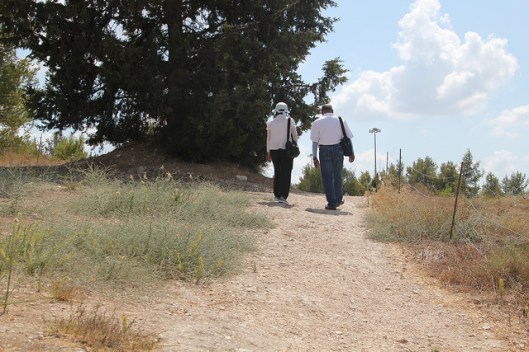
Emmaus

Two disciples walking the path to Emmaus at Nicopolis, Holy Land.


3rd Sunday of Easter
Knowing is Not Enough

We live now in an over-informed age. At a click we have access to any sort of information on any topic; facts, analysis, speculative, sensationalised, real or fake. News tickers update us constantly exhausting us till we are tired of knowing. We find that we shut ourselves from listening and reading, and become selective to what we ‘click’. 

We shun knowing anything that doesn’t directly affect us. 

In this internet age we have easy access to so much news and information, some so incredulous that we are no longer even slightly amazed. It doesn’t matter if it is real or fake, we may not even be interested. If Jesus lived and died in these times and is resurrected from the dead and appeared to a handful of people, how many of us would not have grave doubts? Or actually be even interested if it didn’t directly affect us? 

We are the modern day Thomas. We cannot bring ourselves to simply ‘believe’. We demand that our ‘unless’ is fulfilled with a convincing proof. “Unless I can put my hands into his side, I refuse to believe”. Or perhaps there is no urgent need to ‘believe’ because at this moment we don’t need God in our lives. 

However, knowing is not enough. Catechetical knowledge is not sufficient. Knowing the facts is not enough to bring about ‘believe’.  ‘Believing’ is a process. It requires a personal experience to bring it about. This process actually begins not with knowledge but with a personal encounter with the Risen Christ. 

Incredulous as it may sound to the Thomas in us, this encounter is available to us every day. When life is running smoothly we find less need for an active faith life. Yet he is there hidden under our heavy work schedules and active social life. We pay little attention, or even worse, we reject his existence as the notion that God exists has become too incredulous. 

Often it is only when we face a crisis that we begin to look for signs of the Divine in life. In our desperate need, we want to ‘believe’ however ‘incredulous’ this has been for us before. Because ‘believe’ directly affects us now. But the long period of ‘unbelief’ in us mean that it will take a time process to get us around the incredulity. 

Today’s gospel concludes with this passage, There were many other signs that Jesus worked and the disciples saw, but they are not recorded in this book” 

There are many signs of the workings of the Risen Christ in our lives and these are recorded in the book of our personal life. He has always been present silently working in every small detail. When crisis hit us, we must look into our past history and see how we had emerged from each crisis. There would have been ‘something’ each time that set us on the path of recovery. In that sign of a ‘something’ we see the Risen Christ. 

It is only when we encounter him in our personal situation and see the effect He has on our life, can we rise up to ‘believe’ and say in incredulity the words of Thomas, “My Lord and my God!”


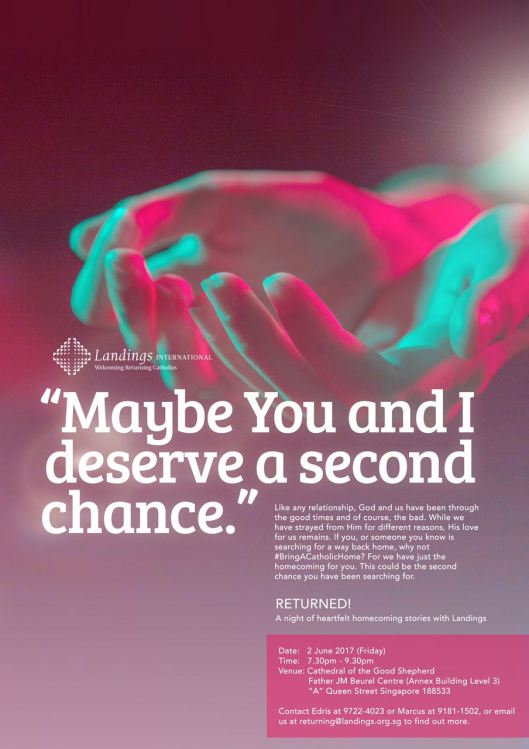
Returned Poster 2017

A poster ad for a Landings event where Catholics who had left the Church and returned share how they came to ‘believe’ after encountering the Risen Christ in the chapters of their life story.

2nd Sunday of Easter (A)

Behind that Stone

There had never been an occurrence when an emptiness said so much. Today we celebrate Easter when the stone was rolled away to uncover an empty tomb. Absent, unseen but present, seen with eyes of faith. An empty tomb filled with nothingness yet this nothingness was so full; full with new life. ‘New life’ made real because He has risen! 

This is the day the Lord has made; let us rejoice and be glad. 

This is a newness we are invited to embrace; to live new each morning as each day brings new hope and new graces. We have no more reason to fear, entrusting our life journey into this presence of the Risen Christ so as to live with true joy and true happiness. Rejoice and be glad! 

But for some of us we cannot rise above the reality of our lives. This Easter joy fades away after a few days because we find that we live life stuck in between the crucifixion and resurrection. 

The resurrection is new energy, renewed each day to replace energies drained away by the reality of daily challenges. We face sufferings of all forms, always magnified to empty us. These hurts are stones from broken relationships, rejections, financial struggles, job loss, illnesses, worries, un-forgiveness, bitterness and this list extend as far as our life journey take us. But it is in this emptiness of our personal lives, just like the empty tomb, where we find Him to raise our lives from the dead. 

Today is a day to give thanks, rejoice and be filled with new hope and renewed faith. The disciples ran together to the tomb. When he went in; he saw and he believed. In that emptiness, worldly life fell into place. 

We too must run into the emptiness of our personal lives. We must look for clues in that emptiness like the linen cloth lying on the ground or the head cloth rolled up in a place by itself; we look for clues by going back into the events that emptied us, and the reasons that we are being emptied. We must move the stone to uncover what is behind the stone. We need to see his presence in our personal life to believe. 

Often it is from many of such events that our lives have taken a turn on its journey and led us to where and who we are today. Personal events, often those that broke and emptied us, become milestones on our worldly journey. People with renewed faith, returning Catholics who have come back, saw enough evidence in their emptiness to know that at each milestone, the Risen Christ was like a new fire that burnt a new path for us. 

We can wait between our crucifixion and resurrection or choose to run to see what is behind the stone. There is nothing there, a nothingness that is full of new life for you and me. Believe, so that we can live in joy and true happiness. Happy Easter!

Behind the Stone

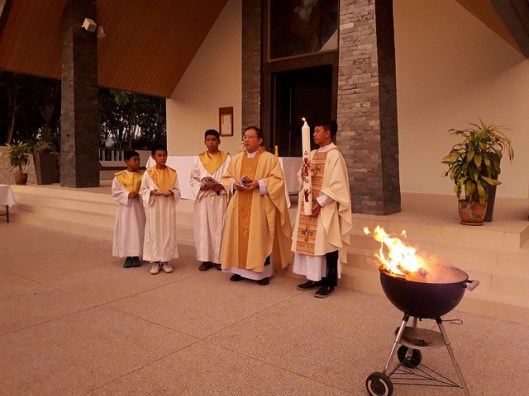
“May the light of Christ rising in glory dispel the darkness of our hearts and minds” Celebrating the Easter Vigil with the new fire to burn a new path for us (Photo: St Joseph Church, Phuket)

Easter Sunday

Mass at Dawn, John 20:1-9


Wait

A woman crippled by rheumatoid arthritis has an itch of her back. Unable to move her bended arms, she cannot satisfy the itch. She patiently wait for the itch to go away. Suffering a betrayal in a relationship, wishing it was never such, the pain cripple us from moving on with life. Time becomes a valued friend in the healing process. We can only wait. 

Holy Week begins. A week to dwell in waiting with Christ as he waited for the suffering and dying that was coming his way. He humbly accepted, “if this cup cannot pass by without my drinking it, your will be done!” There is a holiness about waiting. 

A triumphant entry into Jerusalem suddenly turned to become a gruesome betrayal of a bloody death on a cross. The rhythm of our earthly life share this semblance of triumph contrasting with betrayal, of joys contrasting pains, often not totally within our own control. When the rhythm touches the troughs of sorrow and darkness, it is sometimes fruitless fighting this descend. We can only wait with trust. 

When our life descend into darkness, we tend to look to God and ask, “Why?” Often it is life circumstances that resulted in this trough of challenges; God did not impose suffering on us. Often it is a consequence of our own or another’s decision and action. What we do as people affect others around us. 

It is not God’s will that a large cross falls across our shoulders but God will accompany us on our earthly journey carrying our crosses. As we have reflected during Lent, Christ will be glorified in our suffering lives as he was in the Samaritan woman, the man born blind and in Lazarus. Christ wants to roll away the stone that entombs us.

By our human nature, we fight and struggle against times we do not want. In our weariness, our faith is challenged. We do not wish to drink from this cup. In anger or in fear, we walk away from faith. The cock crow in our life. “’Before the cock crows you will have disowned me three times’. And he went outside and wept bitterly”. In between the tears of bitterness, we realise that the only way to triumph is to wait in holiness. 

Self-giving makes waiting holy. Because self-giving is love for others, and hence life-giving. At the end of this Holy Week, Christ will out of love, die on the cross to give his life to all of us. His patient waiting and humble acceptance is glorified. 

This Holy Week we join him in this holiness as his humble acceptance joins him to our personal sufferings. As he entered Jerusalem, the donkey carried him toward events which he has no control of in his human state. His life, and what happened was to be a consequence of other man’s decision and action. We pray for this Christ-like humility, “He was humbler yet, even to accepting death, death on a cross”, to trust in God and wait patiently as he glorifies our life. 

Waiting in holiness. Quiet waiting. We are waiting for the stone to be rolled away. Wait.

Crucified Spot

Venerating at Calvary where Christ was crucified


Passion Sunday

Move that Stone

A few years back, I experienced job loss. It took me awhile to get over the shock and come to terms with this new state of reality. I felt a deep sense of injustice and battled through periods of anxiety. I journeyed through anger looking for peace but instead discovered a thirst for revenge. I tried seeking justice in the courts but only the rich can afford that. 

It took a couple of years before I found calm acceptance. I had to move on but I found myself trapped in a tomb of bitterness. Early in this episode, a friend had taken me aside and shared a Mandela quote, “As I walked out the door toward the gate that would lead to my freedom, I knew if I didn’t leave my bitterness and hatred behind, I’d still be in prison”. Dwelling deep into this wisdom, I finally followed Mandela out of prison.

“Take the stone away.” I am indebted to this friend for moving away the stone that covered the opening to the tomb I was in.

The story of the raising of Lazarus from the dead teaches us two things: the need to constantly search our inner selves and the reliance of a community of friends to journey life with. The consequent impact can be life changing bringing fresh hope and new meaning to life. 

Everyday events that are negative can bind us especially if we face them alone. From simple anger to devouring bitterness, from innocent dislike to soul destroying hatred, from mild anxiety to deep seated worry, from improper lifestyles to severed relationships, from addictions to sins; layer by layer they bind us like the bands of burial cloth that covered Lazarus. These send us down into the darkness of a tomb.

Each of us have areas in our life that we rather put away. We hide from them pushing them deep into our inner selves. These can be things we have done that is not quite correct, sins we have committed, or things that have hurt us. Left in our inner selves, they become big stones that weigh us down; just like my stone of bitterness that was gnawing me inside, slowly destroying who I am. 

The message of Lazarus tell of the need to be in community. The nature of our earthly journey and our human nature is such that we may find ourselves entombed from time to time. The nature of God is that he want to always heal and forgive so that we can journey in freedom and joy. Life is not a competitive race but our journey together. And the Risen Christ walk with us.

Alone in this darkness where hope seem to all but disappear, we hear the echoes of our name being called, “Come out!” It is Christ coming to our graves to raise us up from the death in our tombs to restore us to new life. He brings healing and reconciliation.

This is our mission: to help to roll away the stone. And when we emerge from the tomb, we will need help from many others to unbind us. “Unbind him, let him go free”. We witness not death but God’s glory, and through it the Son of God will be glorified”. Witnessing the joys of being set free is life-giving; it give us the true meaning of life. 

We need to make “move that stone” our mission.


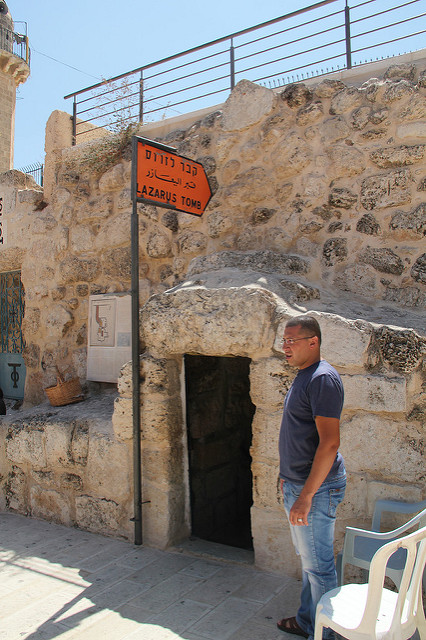
LazarusTomb

Our community visited the Tomb of Lazarus in Bethany, two miles from Jerusalem


Fifth Sunday in Lent


Darkness-giving Light

A brighter light comes out of darkness. Not the brightest thing to say but to make a point that light is more intense when contrast in darkness. It is to illuminate this point: if we come from a checkered past of wrong doing and are transformed to start to have goodness and right living and truth in life, we carry a stronger message of conversion, and perhaps hope, to those who know us. 

And their reaction will be of disbelieving astonishment the greater the contrast when our past of misdemeanor is set against our present of virtuousness. 

During the season of Lent, we constantly hear this invitation to “return to the Lord”. This invite to “return” is not only extended to those who have left the Church but rather it is extended to everyone to embrace transformation from bad to good and from good to better; to “return” ever closer to the presence of God in our life. 

We are all similar to the blind man having experienced some form of blindness. Every one of us have wandered into the darkness of sin and were mired there. We indulged in a lifestyle contrary to the values of the gospel, and perhaps have a catalogue of the many wrong things we did. But one day, something catalytic happened and our life began to change. It was as though someone came along and daubed our eyes with a paste and suddenly our spiritual sight was restored.

When that happened, did we quickly act like the blind man “Lord, I believe and worship him” or did we react like the Pharisees doubting that it was truly Christ who acted in our life?

We all have great stories of our colourful past which “the Lord wants of us” to use. These are real, authentic life testimonies of the power of Christ transforming bad to good. It is especially powerful to the people who know us because they see the contrast between black and white, darkness and light. It is in this darkness-giving light that our lives are called to glorify God. “He was born blind so that the works of God might be displayed in him.”

However we may also choose to remain blind by refusing to see with our hearts. Today’s secularized world continue to pull us away from believing in God. The glittering lights of temptations blinding us to the relevance of God. We are in danger of becoming blind like the Pharisees, gradually becoming doubtful and choosing not to believe, “this man cannot be from God”, and when confronted about God we become hostile and hurl abuse.

We can remain in the pews fulfilling the law of obligation on a Sunday, physically returned but spiritually not returning. We remain blind when we do not accept the empowerment to use our lives to proclaim this presence of God as a constant relevance in life. In us we hide a darkness. But this is darkness-giving light, and when we allow it to shine out, we daub the eyes of those around us. Through us, they see the brighter light of the glory of God.

Sunset Indigo

“You were darkness once, but now you are light in the Lord; be like children of light, for the effects of the light are seen in complete goodness and right living and truth. Try to discover what the Lord wants of you, having nothing to do with the futile works of darkness but exposing them by contrast”


4th Sunday in Lent

The Gathering at the Well

I am a member of a community that meets weekly. We have a common interest that has united and given each of us a sense of purpose to want to gather once a week. We have a specific mission to reach out to Catholics who are away from faith but are contemplating a return to Church. We have sustained this for almost 8 years, not bad in this secularised age. The setting up of this community was inspired by today’s Gospel story: the encounter between Jesus and the Samaritan woman at Jacob’s well.

“Give me a drink”. We realised that a regular gathering to dwell into the spiritual is helpful when daily demands tire us. The secular can quickly take us away from a faith life leaving us in a desert of spiritual dryness unable to connect with the reality of Christ in our daily life. This community was set up to be like Jacob’s well where we gather to quench our thirst

Deep in everyone is a thirst; when manifested it is a search for the existence of the divine in our personal life. Our community remains privileged to witness this thirst in the returning Catholics who come to gather at our well. We, returning Catholics often have a misplaced sense of unworthiness leading us to feel like an outcast just as the Samaritan woman was. 

We dwell at the well of our gathering just to exchange our stories of our week; talking about what’s been happening to us. Together we search for the reality of Christ in the reality of our daily life. Alone our secular life will lead us into a spin that will leave us with a giddiness that disorientate us from the central presence of Christ. This central presence gradually reveals himself through the story of our life just as Jesus did in the life story of the Samaritan woman.

Beneath the brave front we sometimes mask ourselves with, the fact is our worldly challenges can leave us tired and doubtful. Or it could glitter like false gold and we drift away from faith in search of it. Coming together weekly we remind ourselves that only He will give us living water; “anyone who drinks the water that I shall give will never be thirsty again”. It will “turn into a spring inside him, welling up to eternal life”.

“Give me some of that water”. A community cannot be sustained if it becomes more of a social gathering. It must embody a specific mission. The life of a community is sustained by the flow of living water which must not stagnate; the inward freely-given flow increases with the number of outlets. Our community’s outlet is our mission reaching out to ‘away’ Catholics who search for this living water to drink. 

“Come and see” so that these returning Catholics may believe from the strength of our testimonies that will eventually lead them to ”we no longer believe because of what you told us; we have heard him ourselves and we know that he really is the saviour of the world”.

The gathering at the well will continue to grow in numbers provided we ourselves first come to drink and then draw from the well to give to others this living water. It is true that Jesus had no bucket. We are his buckets. 

“Look around you, look at the fields: already they are white, ready for the harvest!”


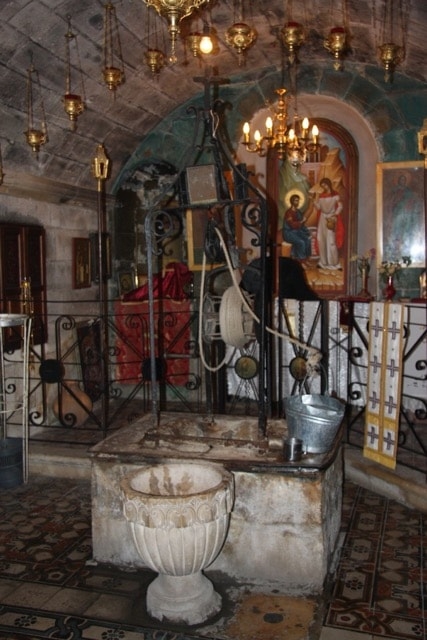
jacob-s-well 2

Our community visited and drank from Jacob’s well at the Church of St Photina in Samaria


Third Sunday of Lent

The Shelter

Do we know anyone who lived life and died without ever facing a personal crisis? Humankind is such that everyone will go through trials on this earthly journey. The truth is our choices and action have consequences that affect self and others. What we choose to do can consequently, often unknowingly, become a crisis for our self or the other person. But our choices include if we choose to travel this journey on our own, or to believe in the Divine to walk with us till our last day. 

No one gets through life without ever facing a crisis. We will find ourselves in situations where we feel helpless, be it from a crisis in relationship, career or illness. Often we walk into the storms of our life unprepared and unsheltered. 

Today’s gospel on the Transfiguration is about humanity meeting divinity. After a quite spectacular encounter, Jesus still had to come down the mountain and walk on to Jerusalem to face suffering and death. Like him, we too will walk towards our own ‘Jerusalem’ to pass through death. It is inevitable. 

The offer of the Divine presence to accompany us is freely available. This too is a personal choice. God has made his choice: He wants to walk with us as we go through our storms. And He constantly call out to us in our everyday life in the situations we find ourselves in. He is here, always present. It is our choice to connect. 

It often begins with a stirring in our hearts; a voice, or a force pulling us towards a certain direction. We do not really know where it will take us but somehow there is a conviction to follow it. This conviction is manifested when we find ourselves restlessly searching for the meaning of life. We find ourselves wondering about the Divine and wander into the faith question. We are drawn deeper into faith, and for some of us, we explore returning to an authentic faith life. 

When we choose to let go and be led, we will come to a point when we will experience our personal transfiguration. It will be an experience that speaks personally to us. This experience is difficult to describe but that moment brings a sureness in us. It is a spiritual encounter where the Divine enters our humanness in a most personal way and the experience leave us totally convinced. It is the moment when we hear the inner voice say, “This is my Son, the Beloved. Listen to him”. 

This spiritual-high encounter will not happen if we do not choose to respond and ‘be led up a high mountain where we can be alone’. Yet the paths leading up this ‘mountain’ are sign-posted on our journey. It can be participation in a programme or being present at a retreat. We need to choose to place ourselves amongst people and in environments where we make ourselves available to encounter the Divine. 

When we embrace the Divine we may sometimes experience that life get even tougher. This is not a penance for our waywardness but rather that God know the storms ahead of us and his relentless pursuit of a personal, spiritual encounter with him is to draw us close to Him. In his unconditional love he provides a shelter to protect and help us weather the incoming storms. 

We can walk under this Shelter towards our own Jerusalem. This choice is ours alone.

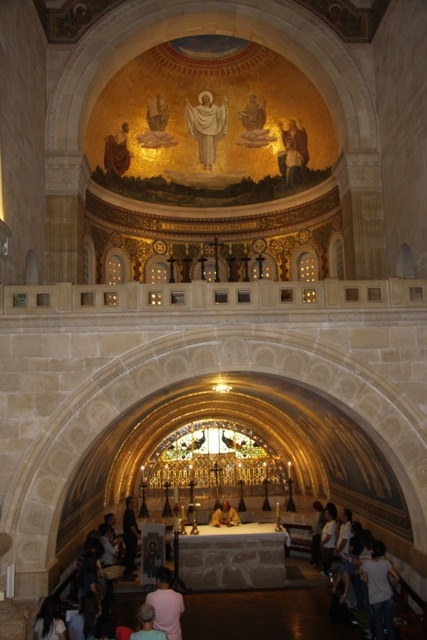
ChurchTransfiguration

Where Divinity meet Humanity. A mass for Landings at the Church of the Transfiguration, Mt Tabor.


Second Sunday in Lent

Desert Crossings

Life is best described as a journey. The landscape changes as we go through the stages of age from infant to youth, to adulthood and eventually into old age; sweet innocence giving way to worries as the path of life bring on more responsibilities. Our little garden of Eden gradually becoming a desert. 

We are now in the season of Lent. We practise acts of self-denial like abstinence and fasting to place ourselves in a spiritual desert.  

As our responsibilities grow, our desires and expectations increase. The environment we live in is increasingly competitive and unforgiving. Competition and the rat race, and the illusion that only the best will survive. Youthful vigour gives way to worries. These days, youth may not even have a chance to blossom as students are stressed chasing for A-grades. This is the reality of today: stress and worry have made life at times akin to travelling through a desert.  

Lent reminds us that “Man does not live on bread alone but on every word that comes from the mouth of God”. This is not about dropping out of life to live as a spiritual hermit. We still need to embrace responsibilities and continue to live. “Bread alone” acknowledges the presence of worldly desires but we need to navigate them with “every word that comes from the mouth of God”. It tells us of the presence of the love of God that help us cross the desert of life. 

Often we heat up under stress and we go into a downward spiral of worry and fear. We fuel our desires for more bread expectant that it will lead us into an oasis of happiness. But in truth, happiness without embracing the love of God is like a mirage in the desert. 

Often desires take us up the mountain of our imagination and we hallucinate about worldly riches that will solve our problems and entitle us to this happiness. Lent protects us from this hallucination when we place the love of God in the centre of our life; the tree of life and the tree of knowledge of good and evil in the centre of our heart. 

Lent begins not when we avoid the skewer of meat or pass up on the glass of alcohol but when we dwell into the emptiness that results from self-denial. Too often Lenten practices have in themselves become rituals and we compete within ourselves to abide but to what end? 

Fasting is the denial of the ‘food’ that fuels our worldly desires and expectations that form mirages. When we pause to dwell into our abstinence, we reduce the glare of the illusions of this world.  

Lent is this opportunity to empty ourselves and embrace the presence of the love of God. This love is the compass that help us navigate the desert of our worldly life.  At the other end of this desert crossing is our ultimate destination. It is the oasis of rich, eternal life. Lent help us cross the desert to reach it. And this isn’t a mirage.

First Sunday of Lent

Worrying returns

We had been preparing for a big event at the Cathedral this week. We were anxious about the choices we made. We were fretful, coordinating all the effort. We were pretty stressed, stretched in fear hoping for all to turn out good. Worry kept returning.

We prayed and reminded ourselves the assurance, “Do not worry about tomorrow: tomorrow will take care of itself” and sang in our hearts, “Seek ye first the kingdom of God and everything else will be added unto you”.  

We told ourselves we had given our best in all we could control; exhausted every idea and expended all energy. The rest is up to God. After all, this event is about his kingdom. And the worry went away.

But worry never goes away. It keeps returning in the other areas of our life. We worry for the future: anxious for our self and loved ones, stressed by our jobs and worry about money. Unlike the worry for the event, these worries do not go away. Why? Because we never fully allowed God control in these areas of our life.

Perhaps because of human nature, we do not see the “kingdom of God” in these areas. These areas are our own kingdom protectively bounded by our desires. We will not ‘let go, and let God in’ because we may not get what we want. And so worrying returns.

Worry distance us from the possibilities of the Divine; it blinds us from his intervention in our personal life. Worrying isolates us, trapping us into an imagined tomorrow that will never come. It takes us away from the real present; this very moment we breathe, this very moment we are alive. It is in this ‘here and now’ where we can find God active in our life, not in the ‘tomorrow’. So do not let the train of worry take us away.

But we have all been away because we have all at some stage in life lost the battle of not worrying. When we are away, we are too distant to make ourselves available to be like “the birds in the sky” and to be “fed by your heavenly Father”. When we depart from the “here and now”, we lose sight of the existence of God.

The event we were organising was about people, you and me, whose worries have taken us far away into the dungeon of our greatest doubt, “The Lord has abandoned me, the Lord has forgotten me”. In this darkness, we are stripped of everything leaving us clinging on only to hope.

It is for one another that we can make real this hope. Worry cannot be tackled alone. We need to accompany one another, sharing our experiences of the presence of God in our lives so as to embolden one another to trust him. To trust him and hand over control of our life; “Does a woman forget her baby at the breast, or fail to cherish the son of her womb? Yet even if these forget, I will never forget you”. 

The event celebrated this mission of people accompanying one another on our spiritual journey to trust God which has led to lives returning to faith. Through trust in him, worrying returns: it returns us into the kingdom of God.

worrying-returns

Postcards of journeys of people where worry once brought us to discover trust in God (Landings event at the Cathedral of the Good Shepherd, Singapore)


8th Sunday in Ordinary Time