Itch for a Reason: Growing in the Christmas Wait

We are waiting for Christmas, or are we not? Waiting is a conscious action, although by its nature there seems to be no action while we wait 😉 Advent is time when we wait for Christmas.

We live in a time in which actions we do in daily life is increasingly automated. We have come a long way from struggling to coordinate hand and feet to find the balance for our car to stay still on a slope. We give in to our incontrollable tendency to shift our gears and run ahead to seek assurance of answers we expect. We are intensely distracted by results; a hurry to live in the future that is yet to come alive, forsaking the present moment in which life is much alive.

Increased automation has indeed saved us a lot of time but where in our life has it all gone? Has it been rushed by our own consciousness into a desired future?

Advent is a time of waiting. Waiting is a conscious action, not an inaction. Waiting is making ourselves alive to the present moment; to consciously grab the gear stick and step on the clutch, and to be aware that your car is sliding backwards. Waiting invites us into the awareness of the present moment and everything a moment can offer to our life.

I used to spend time with a woman during her Advent waiting for the coming of Christ except that it wasn’t Christmas she was waiting for. Her physical body already battered by a myriad of illnesses, bent out of shape by rheumatoid arthritis. In her suffering, time has no escape to a future dream, it stood still, so still, allowing for an acute consciousness of each moment that brings pain and discomfort.

One day I was sat in front of her and she had an itch caused by a mosquito on her back. Her arms were no longer mobile, unable to stretch for the luxury of a scratch. I offered my nimble fingers but she simply smiled and said, “This too is God’s will”. Not so much the itch or the scratch, but this patient waiting for Christ to come to bring her home.

In that moment, there was no need to worry about a future for there is already a sureness about its destination; she was going home to her Creator. It was no longer the end result but the living of each moment to insulate herself from the pain and discomfort of this world. Frozen into each moment was a conscious awareness that Christ is present dwelling in her as her Saviour. He has brought peace upon her. This is Christmas lived every moment in life.

There is no need to rush life into a frenzy because what we are looking for in the future is already present in the present. There is nothing this world has that we can use to barter for true happiness and peace. They are already dwelling in us and each Christmas brings us this tender reminder.

Waiting can bring us this realisation. We grow to become better fruits for the season. Dwelling in the stillness of time and digging deep into our hearts, we may find an itch that needs scratching: the presence of Christ who is asking us to allow him into our lives.

Today’s reading, “Be patient, brothers and sisters, until the coming of the Lord. See how the farmer waits for the precious fruit of the earth, being patient with it until it receives the early and late rains. You too must be patient”.

hellfire-1

As we prepare the way for the coming of Christ by making straight his path, we must be aware of the opportunity to grow while we  patiently wait.

(Photo: On the path to Hellfire Pass, Kanchanaburi, Thailand)

 3rd Sunday in Advent
Christmas Stocktake

December is the best month of the year. There is a certain spring in our steps. The year is coming to an end; if it had been a bad year, we celebrate its ending and if it had been a good year, there is even more reason for a celebration. We are cheerful, noticeably less-tensed, more accepting of one another putting aside differences that pock-marked our relationship this year. Peace prevails.

We are buzzing, looking forward to fun times in the days ahead. We check our schedules, carefully fitting in all the invitations, determined not to miss any. We check and re-check our stock of food and wine, anxious that there will be no shortage, so that everyone will have a rockin’ time. We are preparing the way for our celebrations, making our schedules and resources straight.

“Prepare a way for the Lord. Make his paths straight”

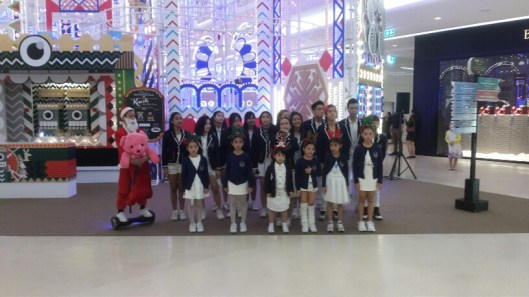
In the malls, children choirs fill the air, their innocence blaring out “We are the world, we are the children, we are the ones who make a brighter day, so let’s start giving”. In the same malls, we hear the ting-a-ling of the bells from the Salvation Army reminding us to share with those who have less. We give. We are more generous this time of the year.

 And so this is the spirit Christmas brings.

For whatever our reason is for the season, and on whichever side we stand along the ‘politically correct’ divide between “Blessed Christmas” and “Happy Holidays”, regardless of whether we are religious or not, believers or otherwise, there can be absolutely nothing wrong with this spirit of giving. And the children sing, “Send them your heart so they’ll know that someone cares. And their lives will be stronger and free. As God has shown us by turning stones to bread, so we all must lend a helping hand”.

For us whose reason for the season is Christ, advent is a time to check and re-check our stock of food in the form of acts of goodness and wine in the form of our spirit of giving. We should rightfully be anxious of how we have lived this year, as to whether our schedules were maxed out with events of the world rather than those of God’s, on whether we have turned our stones of self-gratification into the bread of self-sacrifice. Advent is a time to stocktake on our life.

“Repent, for the kingdom of heaven is near at hand”.

Advent is a time of repentance, not regret. Repentance is a form of preparation, not a ting-a-ling bell counting our past misdeeds. It is a time for resolutions and to acknowledge that there is good in everyone. It is an opportune time to make straight our life for love to flow through us so that we live what Christmas is about – to make the world a better place by loving the other person we meet on our path of life.

We all have this spirit of Christmas in us. Because a long time ago in a stable in Bethlehem a child was born into all of us. This child taught us how to give, and through his giving what love truly is.

20151220_144051_resized

Children choir singing ‘We are the World’ at Central Embassy mall in Bangkok


2nd Sunday of Advent

Christmas is Inclusive

A remark this week from a good friend sparked my thoughts about Advent and our preparations for Christmas. He observed about how the prophesy about the end times is certainly happening when powerful and respected political leaders in the world try at every opportunity to dismantle our Catholic (moral) value system in the name of fairness, courage and inclusiveness, and that they do in the most presentable and slick manner that sounds utterly convincing. 

There is no denying that the world has certainly changed. We live in the 21st century, “wake up please”. There are so many choices to choose from as to how we want to live our life. Liberal choices, conservative choices. It is certainly a long time ago when our Catholic value system was born into the world on that Christmas day in Bethlehem. Since then Man has certainly changed, but God hasn’t. 

God’s love has remain a constant. He constantly calls out to us to watch where we are going, He is constantly reaching out to all people, to everyone; his love never conditional to the need to accept him first. He is constantly welcoming and never ever judgemental. And we know that He constantly forgives in an instant no matter how many instances we ask for forgiveness. All these haven’t changed. 

Christmas is celebrated because a long time ago Man had experienced these to be real in their lives. Slick politicians too as governments they formed declared it a holiday. But like everything else, now we have a choice to say “Merry Christmas” or “Happy Holidays”. We even debate this. 

We can be liberal or conservative but it’s an identity Man created. On that first Christmas day, God gave us an identity that hasn’t changed, that as a child of God. Man created a choice to be liberal or conservative and we spend time judging one another citing our personal rights and man-made laws. God gave us a free choice to live but with a guide to live a morally good life with the assurance that we won’t be judged until our personal end time. He only wants us to know that his love exists in our lives regardless of our identity as liberal or conservative. He says “stay awake, please” to his presence in our lives.  

Celebrating Christmas is not a statement of the lifestyle we have chosen. It is not a platform to argue what is politically correct to say or not to say or how we should be greeting one another. Celebrating Christmas is not about being religious or not. Christmas Day is a day to remind ourselves that God exists.  

We have come a long way in time. Once we were just enjoying the innocent fun of the existence of Santa Claus. Today we try to be ‘correct’ to disprove his existence. We would do well, courageous actually, to accept that Christmas is inclusive, because it happened for everyone regardless of our choices, regardless of our identities, regardless of whether we believe or not.

Do not place Christ beside Santa. Because over time God has constantly loved us as his children, unconditionally and freely regardless of whether we choose to accept or reject.

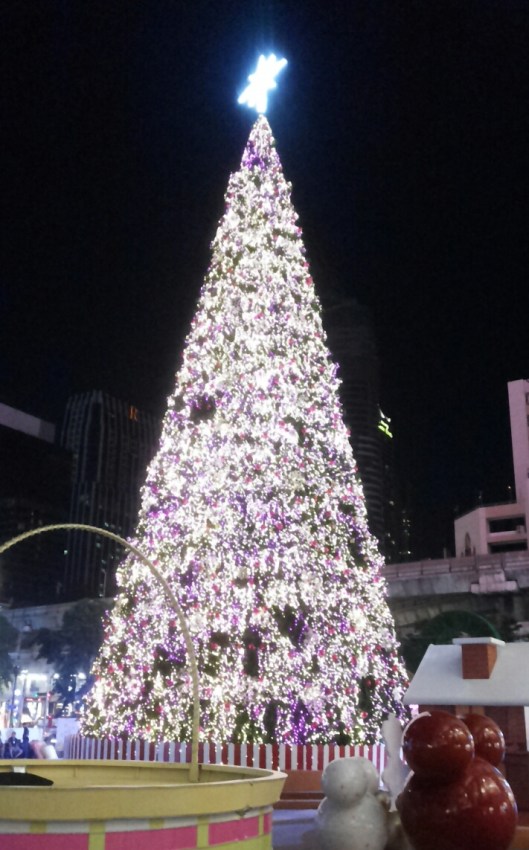
20161127_083929

A Christmas tree in central Bangkok last year


1st Sunday in Advent

Thy Kingdom Come

The homilist this morning insightfully stated that Christ wants to establish his kingdom in our hearts. And he asked if we will allow Christ to do so? For often our hearts are compartmentalised not allowing Christ to rule over every aspect of how we live. 

I would describe myself as such, often living along the borders of the kingdom, dashing in only when I am in need of divine intervention; strongly desiring for an outcome or desperately struggling in a crisis. There is quite a lot of fun living outside the kingdom and I am close to the border line because I live in ways often comprising the laws of the kingdom (in plain terms, ‘sin’).  

I flirt with the possibility that one day, while outside, the door back into the kingdom will be shut in my face. How is it that I can be so foolishly brave?  

I live with a complacency that I have inherited through my faith in an always loving God, a belief stretching into the assumption that forgiveness is always available to me. I only have to knock on the door of mercy.

Today’s second reading spoke of giving thanks to God the Father, who has even open the possibility for me to join the saints and with them inherit the light. “Because that is what he has done: he has taken us out of the power of darkness and created a place for us in the kingdom of the Son that he loves, and in him, we gain our freedom, the forgiveness of our sins.”

As I venture further into my complacency, and further away from the kingdom, my lifestyle reach a border where the world is darkened, brightened only by the neon lights of deception. Over this border, my faith in God is jeered, my belief in his existence mocked. I have reached the secular world of today.

As I reflect on the meaning of God’s kingdom reigning in my heart. I ask myself “do I want to allow this earthly world to consume me?”

“He is the image of the unseen God”

The image of the crucifix. A King with a crown of thorns. A body scourged and bloodied. Nailed to a cross. Hung to die. A sorrowful sight, but an act of love defying every border of human understanding, every limit of pain in the name of Love. The power of Love. The image of the resurrection: “He was first to be born from the dead”.

Behold the sight for this was the ransom paid for me to live my complacent lifestyle. Is this how I have chosen to repay my King?

It is time to give thanks and knock foolishness out. And allow access to all of my heart for the Kingdom of God to reign, and have a lifestyle to witness for Christ the King.


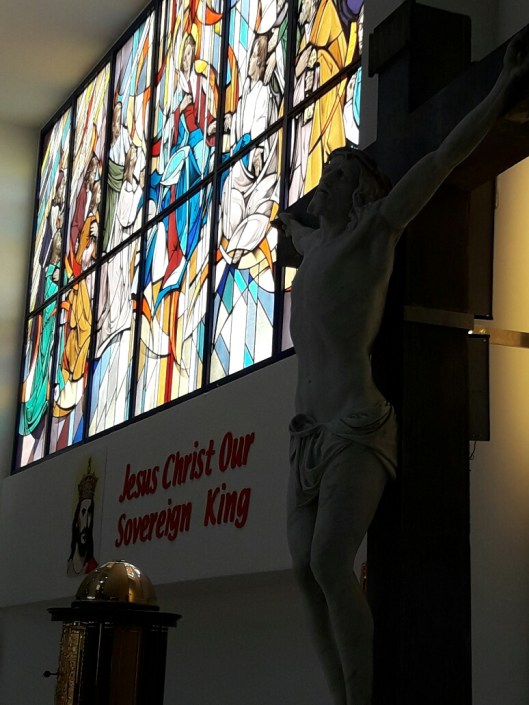
20161120_080059_resized

“He is the image of the unseen God”                 (Church of the Holy Spirit, Singapore)


The Solemnity of Our Lord Jesus Christ, King of the Universe

Blue State, Red State, our Inner State

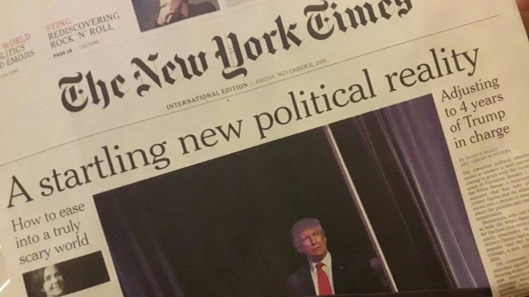
By some work of the Spirit, this Sunday’s readings speak somewhat of the mood of the world following this week’s US Elections. The surprised world greeted Trump’s victory with fear. Many fear this to be the beginning of the end. Doomsday scenario as painted in the first reading. “The day that is coming is going to burn them up leaving them neither root nor stalk”. 

Red state, blue state, this has been a divisive campaign with many issues threatening core values. Protests on the streets and on social media indicate that wounds run very deep and healing is much needed. Yes, the President of America can start a healing process and he must. But amidst all this uncertainty and fear, a government has no power to change our inner state, our core values and reset our moral compass; that power still belong to us as individuals. 

Governments may not always make pro-life choices. As a government they can legalise abortion, and as a government allow for that choice. But it is up to the individual to decide based on their own belief. We cannot force a non-Catholic to conform to what Catholics believe in. We could vote blue but still make Catholic choices. 

We must not allow governments to dictate who we can become. They are a kingdom of this world. If every individual have been living according to the laws of the kingdom of heaven, the world would not be even near this divisive state. “Nations will fight against nations, and kingdom against kingdom”. Beneath all this rubble, it is within our power to retain our values as a Catholic. 

And make a difference. There has been no better “opportunity to bear witness”, no better sign to show that the only kingdom that can withstand total destruction is that of God’s.  

Governments can build walls and divide God’s people through colour, race and religion. How have we arrived back here? We must look deep inside ourselves and see if there aren’t already walls we ourselves have built inside us. If the walls are there, there is little difference who a physical wall along the border can keep out. We could vote red but still make Catholic choices. 

The sooner we realise this the better. There will only be one kingdom that will reign. “All these things you are staring at now – the time will come when not a single stone will be left on another; everything will be destroyed” 

Let us not live in fear of a presidency but let us live in fear of God; to “fear God” is different from being scared and afraid of a president’s policies (and lifestyle!) but to have awe, wonder and reverence for God and to be subjects of his love.  

“But for you who fear my name, the sun of righteousness will shine out with healing in its rays” 

In our everyday life, the election isn’t over. In every moment we can choose to love and be righteous in all be do. We can bring walls down and bring healing in.  

Hey man, we all need the sun.


20161113_102709

33rd Sunday in Ordinary Time


Crossing the Divide

Most of us believe in life after death. We believe “in the resurrection from the dead”. But many of us are preoccupied in trying to get the best out of our daily life to pay much attention to an eventuality that will happen to everyone. It is almost like saying “we’ll see what happens when we get there”.

But “get there” we all will; some blessed with time to prepare through illness while others unfortunately, all too suddenly. Today’s readings speak of crossing the divide between life and death. Through quite a dramatic account, the first reading speaks of the choices we make in our daily life, of whether we have the chosen the way of God or that of man.

The “way of man” is present in the daily buzz and busy-ness of daily life. This buzz and busy-ness is not in itself wrong. In fact, born into this world we must journey through it but in this buzz and busy-ness are the opportunities for us to make the choice to live “the way of God”.

“Ours is the better choice, to meet death at men’s hands, yet relying on God’s promise that we shall be raised up by him; whereas for you there can be no resurrection, no new life”.  

To die is to cross a divide so as to live on. The choice for most of us to live on into “new life” does not come at the point of death but gently, forgivingly in each choice we make in the buzz and busy-ness of daily life. It is in the small actions of what we do for others that our choice for new life is made.

We must live life in the fullness of Christ. We must live a life of selfless giving for others and for God. And when we do so, we make real for others and ourselves the assurance given to us at baptism for “they can no longer die, for they are the same as angels, and being children of the resurrection they are sons of God”.

We can be this experience of hope and promise to the people we encounter in our daily life, especially in all we can do for them. Personal experiences are powerful as they set us into a deep conviction and onto an unwavering course to claim the promise of life after death.

We were at the bedside of a loved one waiting for death to take her away. On the night of the fifth day of the vigil she said that it was difficult to die as we were clinging on to her. Asked if she wanted a personal goodbye from each family member, she asked instead that we all gather around her bed for prayer. At the end of the prayer, she waved her hand in farewell uttering, “Alleluia, alleluia! 

She was never schooled and is not able to read nor write. Her participation in prayer with us and at mass had always been limited to one word. “Amen”. For her to say “Alleluia” was extraordinary in itself. She also then waved away attempts to pray on.  

With “Alleluia, alleluia” as her final words to us, she began crossing the divide between life and death. By the time the sun rose to a new day, she was across on the other side.

When she uttered “Alleluia, alleluia”, she must have seen the angels and all her loved ones who had gone before her descending with the communion of saints to bring her into new life after death. For that must be the reason for her to proclaim “Alleluia, alleluia!” Glory and praise to God, indeed. She must have seen.

 She lived her daily life choosing the way of God, clinging on to the beatitude “for blessed are the poor in spirit, for theirs is the kingdom of heaven”.

Experiencing this crossing of the divide made the resurrection from the dead powerfully real for me. I too ‘saw’ and can respond with today’s psalm, “Lord, when your glory appears, my joy will be full”.

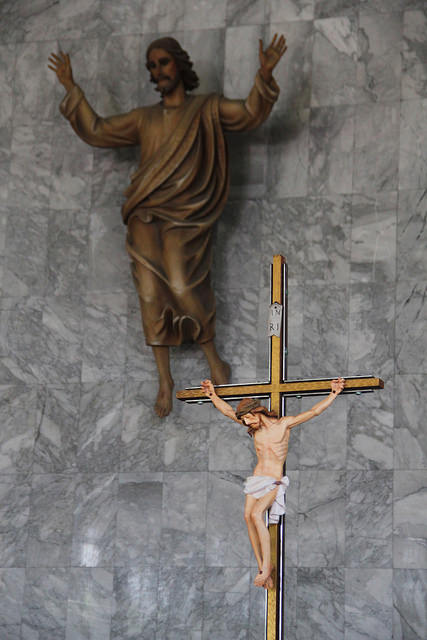
blessednicholas

Following Christ across the divide: from the cross of death to the resurrection of new life (photo taken at the Shrine of Blessed Nicholas Bunkerd, Nakhon Pathom, Thailand

32nd Sunday in Ordinary Time

Change is not that difficult

Last Saturday in Bangkok, more than 200,000 people gathered to sing the royal anthem in tribute and remembrance of the late King. Individually they came, collectively they formed a sea of black clad mourners. These past 2 weeks, witnessing this expression of love has surprised, and at times overwhelmed me, a foreigner living amongst them. Literally, I wish I could climb a tree to see this touching spectacle, this manifestation of emotions, this sea of unifying love. 

Love surprises when it brings us far beyond what we thought are our limitations. It overwhelms when it touches us deep inside, perhaps right where our true identity lies, the core of our being, often hidden beneath expectations and desires of our worldly life. Supressed, subdued, awaiting a call to be set free. 

Many of us are like Zacchaeus. We deem ourselves somewhat unworthy, disbelieving that we are deserving of God’s grace. Amongst people who know us, it will seem unlikely that we are capable to live a holy life. We are camouflaged by the world, our manifested identities lost in the changing colours of a chameleon. But deep in each of us we all have a desire for good. Embedded in this desire is a constant call to bring this identity to the forefront of our lives; to live it. “For the Son of Man has come to seek out and save what was lost”. 

This call is amplified when some things happen to us in life and through these experiences our innermost identity is touched and aroused. It is especially amplified when we experience love over hurt. It moves us when relationships are mended and we reconcile. The joy it brings can overwhelm us to the point of wanting to change our lives; the love experienced, an inspiration to conversion. 

We must seek out experiences of love and save what had been lost in our personal life, and it could be our relationship with the Son of Man. 

Change is not that difficult. Who we can become is already in all of us. We only need to “climb a tree”, to take a physical step however small that may be to demonstrate that we are a willing party for conversion. That is good enough, and God “will make you worthy of his call, and by his power fulfil all your desires for goodness”. It ask only for a small step and an ounce of faith and he will “complete all that you have been doing through faith”. 

We must have heard our fair share of stories of people who have encountered the love of God through reconciliation and how their lives have changed for the better. We have been curious by the transforming effect in people around us but despite it, some of us may still find ourselves stalled in spiritual inertia. It may be due to our perceived unworthiness or lack of belief in ourselves. But sometimes we are simply contented being “ourselves”, unfussed by the tiny ounce of curiosity.  

We must then be like Zacchaeus, not suppressing our curiosity but “climb a tree” to address our “anxiety to see what kind of man Jesus is”. His simple action opened the door to his inner self, into his hidden true identity of one who knows love, is loved and can love. It opened the door to ‘change’ and began the process of his conversion. “Hurry, because I must stay in your house today”. 

Love as I have witnessed in Thailand is a powerful tool of conversion. Alone, it transform self; together it transform a nation. It brings us beyond personal boundaries and we discover the grace to reconcile. Together it unifies, crossing divides of differences. Love gives hope, and with hope, sadness will become joy. 

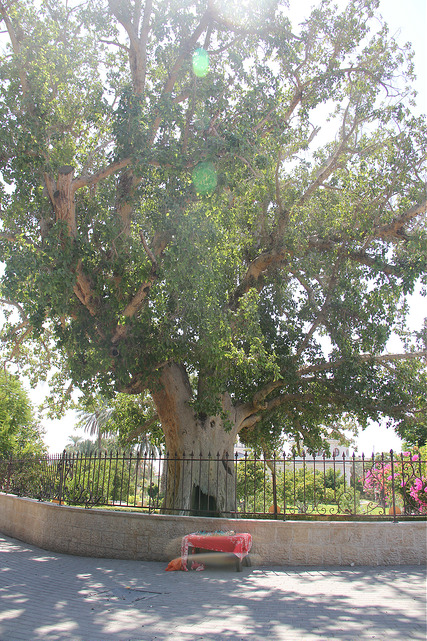
But it begins with me. I must make that effort to go to the Palace to be part of the 200,000. I must do my small part; I am called to conversion. Individually we change, collectively we become an ocean of good. Change, conversion, is really not that difficult. We only need to tell ourselves, “I must climb the sycamore tree”.


sycamore-tree

A centuries old sycamore tree in Jericho


31st Sunday in Ordinary Time

Tug of War

I have fought the good fight to the end; I have run the race to the finish; I have kept the faith; all there is to come now is the crown of righteousness reserved for me. 

We oscillate between self-made and God made. There is a tug of war between worldly and spiritual. Exalted against humble. Self-righteousness versus true righteousness.

Our identity falls somewhere in between that of the Pharisee and the tax collector. We know we need to be humble but struggle to remain. The races of this world declares a winner when we have left everyone behind. The race St Paul speaks of is not of winning but of completing. “I have run the race to the finish”.

Everyday life constantly demands a race out of us. We fight to be the best in school, at work, in social life and in everything we do. Meritocracy is the system, and often there is nothing much wrong with that, and there is nothing much we can do about it. The world rewards a winner. And so ‘I’ need to excel and to exalt myself.

Christian life reminds ‘me’ that every time ‘I’ win, there will be a trail of disappointed people as a consequence. But I cannot give up my place in university or my promotion at work. I have earned it. It is mine. ‘I’ am blessed with abundant gifts and talents. ‘I’ have made the most of it, seizing opportunities that come my way. A self-made man, “God, be thankful for me, a winner” who have used your gifts to the full.

Everyday Christian life calls out to us. It reminds us of the people around us, those left in the trail of disappointments; those perhaps who have less than us. To win the race in everyday life, we have to use our talents and outfight everyone else. To win the race in Christian life, the one St Paul described, is to use our talents and help those around us, to finish the race.

Christian life is a journey. Born into this world, a journey that can take us in many directions. Like an open desert, we can go in any direction but risk being lost. But God has given us a compass and equipped us with talents.

Our race is to get away from the poverty of this worldly life into the riches of the heaven of eternal life. On the way, we fight the elements of this world, the distractions that will lead us off course and deeper into a desert of spiritual poverty. To God, the ‘winner’ are those who complete the race of life, not by being the only one emerging from it, but rather how we fought to stay the course of Christian morality. He crowns those who had been righteous in his name.

Often it involves us using our gifts and talents to help the neighbours along the way to finish their race as we finish ours. It is not about crossing the finish line alone and ahead of everyone else but rather to cross it with as many neighbours as we can in whose lives we had made a helpful impact.

Our present identity probably falls somewhere in between that of the Pharisee and the tax collector; the value system of this world constantly lures us deeper into desert of spiritual poverty but the voice of the Spirit is often heard in the desert calling us into a humility of total dependence on God to lead us into heavenly riches. This tug of war, this oscillation, is our conversion process.

This is our true race: to complete our conversion when instead of saying “God be thankful for I am a winner”, we say “God be merciful to me, a sinner”. In this fight to complete our race, humility is our grinding stone. To God, be the glory.

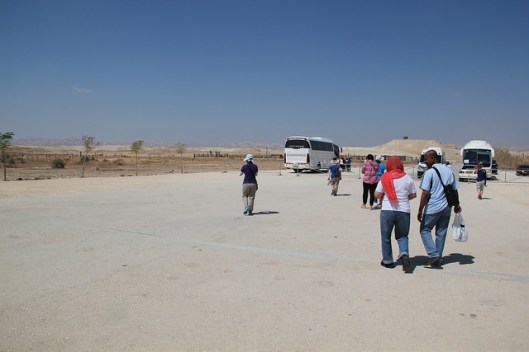
desert

The journey to complete our race of life. We fight to get out of the desert of worldly life into the oasis of heavenly life

 30th Sunday in Ordinary Time

Weary in asking, Tired in giving

When life is completed it will look like an intricate mosaic. We are each like a small mosaic tile, insignificant on our own but together become a beautiful image. The image loses perfection with the absence of one single tile. It does not matter which part of the mosaic we sit, even if we are right in the middle. Because alone, we cannot carry the overall beauty of the image of the mosaic. When we live life side by side with one another, we each play a contributing role in the beauty of life. 

Life is this intricate mosaic. We ask for space to fit in among other tiles. At the same time, we must give space to ensure that neighbouring tiles fit in around us. In life, sometimes we ask, sometimes we give. We can sympathise with today’s poor widow asking but often in life we also play the role of the judge, unjust in many ways, often in delaying to give when we can. Other tiles have to wait to fit in around us, and they may wait a long time. 

When we pray to ask God for something in life, he as the Ultimate Giver will want to grant it to us. But he depends also on others to cooperate in the giving. If left up to him alone, there will be no hunger or poverty in this world. But worldly life is a journey towards salvation and on our ticket to this ride, it states that we will all be given a free choice to give and take. We, as “others”, have a choice to exercise our right to give, and how speedily we choose to exercise this right.  

In God’s picture of salvation, each tile has just rights to sit beside each other. This is God’s plan, this his will. Ultimately, we will all fit. This is his faithful promise.

Today he assures us, “will not God see justice done to his chosen who cry to him day and night even when he delays to help them?” but we “need to pray continually and never lose heart” or “to pray always without becoming weary” 

In asking, we can and will be tired of waiting because of our human nature. But because we live in faith journeying towards the promise of eternal salvation, we must not grow weary or lose heart. The answer will come.  

In giving, we can soothe the tiredness of others by reducing the time of their waiting when we give speedily. We as a single mosaic tile must polish our rough edges so that other tiles can fit in beautifully around us. “Giving” is this polish. This is the wisdom from the second reading today, “the wisdom that leads to salvation through faith in Christ Jesus” as we have a capacity to be a dedicated giver “fully equipped and ready for any good work”. 

Life in motion is the dynamics of asking and giving, each person co-existing next to one another. The perfect mosaic of salvation is to have every tile smoothened on its edges in place, all together forming an image that tells a perfect story of our journey together to claim salvation. God, the ultimate giver himself provides his Love as fuel to set life in motion, and the glue that hold all the tiles in place in picture perfect harmony. 

Moses, on journey in the first reading, is this image of perfect harmony. He raised his arms up till they were tired in asking but he never grew weary because he knew of God’s love. As he asked, he was also giving; his tiredness pushed his capacity to its limits. Through his giving “the edge of the sword of Joshua cut down Amalek and his people”. 

For us to be the one tile in the mosaic of life, we must not be weary in asking nor tired in giving.

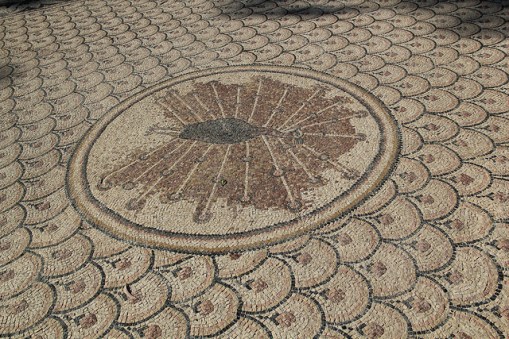
mosaic

Each tile insignificant on its own but together become a beautiful mosaic at the house of St Peter in Capernaum


29th Sunday in Ordinary Time

Gratefulness – The Gentle Stairway to Heaven

To be thankful and to be grateful is quite different. The 10 lepers in today’s passage would very likely all have been thankful to have found themselves cured. Being thankful is part of our human nature. If we found ourselves in the situation of these 10, we would have muttered, or even shouted “Thank God!” 

We would have gone on to capture the moment with a ‘selfie’, texted on instant messaging and posted on social media. We would have celebrated excitedly with friends and family this “miracle in my life”. Since we have been taught that God exists and “He can do great things” we may simply feel lucky to be a recipient of this gift. We do not get far beyond the point of muttering our thanks and nodding in heaven’s direction. This would have been so for many a number of factors but one of which is that we lack the awareness of God, present and interested in our personal life. 

One of ten dwelled on the moment. In dwelling into what had just happened, he silenced the distractions around him and overcame ‘the urge for a selfie’. In the silence he felt thankful, deeper down in him he felt a sense of gratefulness. The gratefulness was calling out to him to seek the Giver. He responded and through physical healing he found spiritual bliss.  

God is active in our everyday life but buried and hidden under the mayhem of the distractions of our worldly desires and priorities. Often unseen and unrealised, God puts to order the disorder of our personal life. Because of his unconditional love he will continue to do so for any “10 lepers” even if 9 went away each time without gratefulness.  

Gratefulness is a powerful blessing. It is a blessed tool to open our eyes to see the powerful presence of God in our personal life. Gratefulness opens up our heart to respond to this divine presence every day, every moment. Through gratefulness we become acutely aware of God and enter into a personal relationship with him. We go beyond the moment of thanks into the spiritual bliss of experiencing our faith.  

Gratefulness is a gentle way to journey towards God. God calls us to be closer to him every day but often we cannot hear his call amidst the loud cacophony of our daily distractions. We are much like the 9 lepers too busy and too excited wanting to get back quickly into the rhythm of our worldly life, not wanting to miss a beat.  

Often it is easier to see and hear God when we are in deep despair, when we have not much left and few people to turn too. In a prolonged period of darkness we stretched out our hands and grope desperately to find a divine presence. We break thresholds of pain through emotional sufferings before we wise up to embrace faith and go through healing to discover that God is present in our life every day, every moment. 

Gratefulness helps us to bypass the rough steps to climb towards God. Being grateful, not just merely thankful, for the many small blessings in our daily life keep our heart and eyes open to an unseen God who through his unconditional love want to be visible in our personal life. Being grateful is to dwell in God’s presence. The opportunities comes to us in many small gentle moments each day.

We can choose how we want to live our life. We can walk towards our Giver of life, thanking him each step along the way. And like the one leper, we can opt for the path of gratefulness as it is the gentle stairway to heaven.

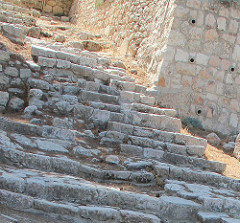
21467947420_0727fd188f_m

Stone steps by the Church of St Peter in Gallicantu on which probably Jesus walked on from the Last Supper to Gethsamane

28th Sunday in Ordinary Time