• About

always returning

~ a journey from head to heart

always returning

Author Archives: tonysee

Press Pause

03 Monday Dec 2018

Posted by tonysee in The Next Mile

≈ Leave a comment

We take our first step into Advent; into a season of waiting and preparation for Christmas. It is a time for a pause, to reflect where our daily life is taking us spiritually. I had been missing from this blog for the last two Sundays and today I am a day late. I had a text from a friend this morning to check if I was OK. It awoke my spirit and returned my discipline.

What we do and focus on in daily life can easily take us away. It can create many openings to lure us down a path of spiritual dryness. There is nothing wrong with daily life but we must watch how we allow it to affect and control us, which can eventually bring us to ruin. I had been pulled away by work demands on my time. Without pausing, I allowed the tide of daily life to carry me, faraway enough to be then lured further away by distractions and then into an undisciplined lethargy towards God.

“Beware that your hearts do not become drowsy from carousing and drunkenness and the anxieties of daily life, and that day catch you by surprise like a trap.” (Gospel)

The season of Advent reminds me of the coming of Jesus, who already is here but is often forgotten and lost in the motions of our daily life. Pausing to reflect is the call of every Advent for us to check on the focus of our daily life. “We urge you and appeal to you in the Lord Jesus to make more and more progress in the kind of life that you are meant to live: the life that God wants”. (Second reading). This is an appeal to be good; to allow love to flow through us to love the other.

“May the Lord make you increase and abound in love for one another and for all” (Second reading).

We live in a relative world. Being good is actually not that tough but rather being bad is all too easy. Imagine a world where everyone is good, where love freely flows in that we truly love one another. In that spiritual energy, it would not be difficult to also be good. But this real world isn’t that ideal world. In this reality the forces of bad pull us away from true love into the confines of self-absorption.

This is the physics of spiritual life. Our daily life must always be in the motion of doing good deeds to allow love to flow through us. Spiritual dynamics does not allow us to stand still, where we are not bad but also not proactively doing good things because the forces of reality will drag us into the lull of spiritual dryness. In that lull we will forget that Jesus has come into our lives; a forgetfulness that will lead into the dangers of disbelief.

Advent has its reasons. Pausing and reflecting on where we are in daily life allow us to reset the course of our life. Jesus is always coming, we need to be always returning. Pressing pause helps.

“Be vigilant at all times and pray that you have the strength to escape the tribulations that are imminent and to stand before the Son of Man.” (Gospel)

Xmas Tree 2018

First Sunday in Advent 2019 (Year C)
What little we have

11 Sunday Nov 2018

Posted by tonysee in The Next Mile

≈ Leave a comment

We wake up each morning and take our place in the hierarchy of life. That hierarchy is often arranged according to power, influence, status and wealth. This hierarchy is flaunted through nice clothes, greeted obsequiously in public places and dine in the finest establishments. When we have little to offer, we keep our heads low and just go about our daily routine.

Jesus is a friend to the underdog. But that does not mean he is not a friend to the well-heeled. He is a friend to every person with the concern that each soul is not taken away from him. In today’s Gospel about the poor widow he tells us that power, influence, status and wealth are corruptive elements to the pure soul. Too much of them can disguise our intentions, deceiving our very own self.

His litmus test is not the amount we drop into the offertory but our effort, sacrifice, trust and love that accompany the giving. He admires us when we have little and still give a portion of that little, not to him, mind you, but to someone else who we think will be more in need than ourselves. It is too easy to give out of our surpluses, and at the same time look good for it.

“I tell you solemnly, this poor widow has put more in than all who have contributed to the treasury; for they have all put in money they had over, but she from the little she had has put in everything she possessed, all she had to live on.” (Today’s Gospel)

It is not merely about surpluses in money. The spirit of our giving; the reasons, the intentions and the heart in the giving flattens the inequality among all persons created by the unequal distribution of world wealth and power. Jesus uses both widows in today’s readings to teach that the wealth of eternal life is measured by the size of our heart in the giving – and that heart cannot give money but love, faith and trust. In this every human person is made equal.

The more we give out of the little we have constitutes trust, faith and love. And this isn’t about money.

In the hierarchy of worldly life, we may be way down the ladder because we are lowly educated and socially awkward. We struggle to contribute to anything because the world has inflicted upon us an inferiority complex. Today’s message gives us genuine hope that the little we have to offer in terms of talent and ability will be fully appreciated. Only Jesus alone know how difficult it has been for us to make a difference, and that every ounce of effort we put in is not from our surpluses. We must not let the world extinguish this hope.

Hope and trust is a couple that leads us into greater faith. When we run low on hope in worldly matters, we are called to empty ourselves and put all our trust in him. When we have little, and still give in trust and faith, our jars in life will never empty.

“Jar of meal shall not be spent, jug of oil shall not be emptied, before the day when the Lord sends rain on the face of the earth.” (First reading)

20181111_170401_resized

‘Please’ he said ‘bring me a scrap of bread in your hand.’ ‘As the Lord your God lives,’ she replied ‘I have no baked bread, but only a handful of meal in a jar and a little oil in a jug; I am just gathering a stick or two to go and prepare this for myself and my son to eat, and then we shall die.’

32nd Sunday in Ordinary Time

It’s not in the Ten Commandments

04 Sunday Nov 2018

Posted by tonysee in The Next Mile

≈ Leave a comment

‘I’ grew up attending catechism classes in the late 60’s. Maybe I was a poor student. I seem to recall that the most important part of my Catholic faith was to memorize the Ten Commandments. The words of Moses were drilled into me, “If you fear the Lord your God all the days of your life and if you keep all his laws and commandments which I lay on you, you will have a long life”. (Today’s first reading)

My Catholic faith life was built on this literal fear of God. It took me a life journey to understand that God-fearing was not this type of fear. My God was almighty, distant and authoritative. God is always waiting to punish if I broke any of the Ten. For a Catholic like me, the idea that I can have a personal relationship with God is an impossible, somewhat sacrilegious, concept.

My belief in God was largely a personal matter. I was never comfortable sharing it. The only outward sign was my attendance at Sunday mass. I was however, a strong believer without any challenging doubts. I worshipped God, and I literally feared him. But was I really in love with him? “You shall love the Lord your God with all your heart”.

I must have missed class or was not listening when they taught this: “Jesus replied, ‘This is the first: Listen, Israel, the Lord our God is the one Lord, and you must love the Lord your God with all your heart. The second is this: You must love your neighbour as yourself. There is no commandment greater than these.’” (Today’s Gospel). For the longest of time, I was caught in this one dimensional vertical aspect of God, Church and faith. I was also praying fervently without hearing any answers.

God’s mode of communication is mostly through our ‘neighbour’. Whatever God wants to do for us, mostly it is done through the acts of people around us. Often the answer to our prayers is heard or seen through our ‘neighbour’. God communicates a lot with us. Often his strongest messages come through the love our neighbours have for us, be they family, friends or strangers.

We need to fall in love with God. It is through true love that I finally got to know a personal God. The more I encountered love in my neighbours, the more I encountered God in daily life. The more I participated in this call to love God and love my neighbour, the better I know God. In truth, he isn’t distant or authoritative. The more encounters I have with God, the closer I feel towards him. And through all these encounters, a personal relationship with God developed. It is no longer an impossible concept.

We must come out of hiding. Our faith is not a personal matter, “between God and me”. It is not just about memorising the Ten Commandments but about having a personal relationship with him. For that to happen we must allow God to communicate with us.

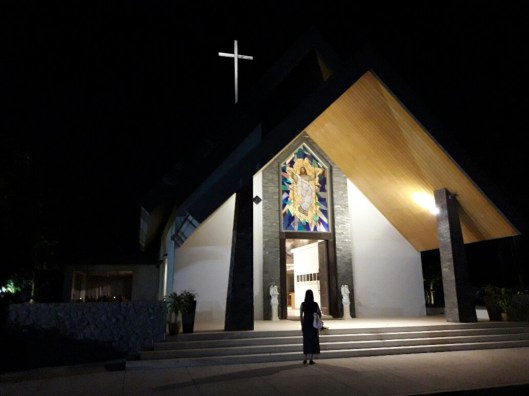
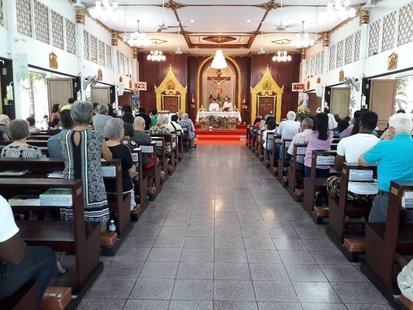
Pattaya mass

God is not only in the vertical between me and God but is encountered more in the horizontal aspect of our faith – in the acts of love for our  “neighbours”.

31st Sunday in Ordinary Time

Blindness of Heart

29 Monday Oct 2018

Posted by tonysee in The Next Mile

≈ Leave a comment

Many eyes are now shutting to matters of God. Going to Church seems like an ancient rite. Our gaze is distracted by newer and more alluring lifestyles. Newer issues, more interesting topics are drawing us away from Church teachings that never seem to change. The Church seem less relevant to our daily affairs.

The world is in an over-informed age. All sorts of information is available at the click of the mouse. Information, ideas, opinions keep piling into us. We have suddenly become overgrown with knowledge. Our human mind is excited. There is a new world to explore. It is time to depart from ancient tradition.

Evangelization has become more challenging than ever before. Even the target audience has changed where once we search for non-believers, we now seek those who once believed. But our discussion, debates and arguments about Church have become less convincing, our words of persuasion are ringing hollow. Time has seemingly left us floundering in her wake. God has become old fashioned.

We cannot continue to teach and convince with knowledge alone. We are churning out the same old information, using the same old proof of God’s existence. We cannot continue to proclaim that God loves us unconditionally, and plus that He is present in our life, somewhere. We would be met with a shrug. “Read it, heard it, no thank you”. The world is speedily moving along, our methods like an elephant ambling slowly behind.

Knowledge and facts about God and his Church continues to be most important. They cannot change. The truth does not alter. The unconditional love of God is a constant.

But knowledge alone no longer convinces. Targeting the head, debating faith at an intellectual level is more often a miss for many people today. People now look for experiences to pleasure their senses. To evangelize today, our methods must change to also home in on the senses. We need to target the heart.

The heart can only be delighted when it begins to feel this love of God that knowledge proclaims. Knowledge of love must become acts of love. Preaching the presence of God must become making real this presence. We, the bearers of knowledge must become the porters of love. We must step out into the world to represent his presence, to make love tangible. Only then can God be relevant in our daily affairs. If not, evangelization fails.

Unless we start embarking on our journey from head to heart, our journey into blindness of the heart will continue. To lift the blindness besetting the world, knowledge cannot remain as knowledge, it must flow to become actions of love. We must give flesh to the bones that is knowledge.

“Son of David, Jesus, have pity on me. Let me see again”

Picture1

God’s unconditional love for us is a constant since time began. But the world has kept on evolving. Our methods must change to express this same constant. It is more urgent today to express faith not only with head knowledge but heartfelt actions. Only then will people walk back into Church when God is seen to be relevant.

For yesterday, 30th Sunday in Ordinary Time

Rise above instinct

21 Sunday Oct 2018

Posted by tonysee in The Next Mile

≈ 2 Comments

It is instinctive to want to be great. Natural, to want to lord it over others. But as humans, we are the highest life form. We have body and soul, and the faculty to rise above instinct. We have the fullest capacity to choose. But with greatness comes authority. Using authority, we have much more to choose from simply because we are first to decide. Greatness is a temptation.

“No, anyone who wants to be great among you must be your servant, and anyone who wants to be first among you must be slave to all. For the Son of Man himself did not come to be served but to serve, and to give his life as a ransom for many”. (Today’s Gospel)

Greatness must be out of the spiritual equation of desires. Because greatness recognizes the element of ‘self’ in however small degree our faculty enable us to control that recognition. In the pureness of spirituality ‘self’ has no place. If ‘my’ intention to be “slave of all” because ‘I’ want to be great, then that itself is already wrong.

Servanthood is about dying to self. It is a journey into self-giving. It is faith growing into action. It is living “Christ must increase, I must decrease”. It is about choosing to drink the cup that Christ drank from. It is about making progress towards becoming Christ-like to give our life as a ransom for others. It is wisdom to embrace that true love places self-love last.

We are of course, mere mortals. Our faculty, body and spirit, is much below that of the Son of Man. His divinity, absolutely. His humanity, can be an aspiration. But let’s not go there but remain mere mortals.

James and John did not seek greatness to benefit themselves in this material world. They had already given up everything. They were asking a spiritual reward but from the mind of a mere mortal. And they were rebuked. In that rebuke, every mortal was offered the wisdom of servanthood. It is an attitude-changer for us, putting into perspective how to drink from his cup and to live our life as a ransom for others.

The more authority we have, the better servants we can become.

Every day we can drink from his cup to draw strength to become a blessing for the people we will encounter in our day. Every day we wake up to take our position in society in our responsibilities in family, job and relationships. Every day we use our God given talents to do an honest day’s work. Every day we think about our ‘self’. Today we are invited into the wisdom of servanthood, called to change our attitude.

We are created for one another. Each have a different talent, each bestowed a different position. Each talent and position complementing and not competing. We are individual pieces of a jigsaw. Our ‘self’ is important but no more important that the complete jigsaw that make up the world. We exist, and survive, as a collective. We are parts of the One Body.

The prize of life is in the effort we give to share our ‘self’. God judges effort, not result. He alone will know all the mitigating factors that challenges our servanthood. For us mere mortals we are called to rise above our instinct and just try.

Choose servanthood and become a blessing to others. Make today amazing for them.

Cup

29th Sunday in Ordinary Time

The following Question…

14 Sunday Oct 2018

Posted by tonysee in The Next Mile

≈ Leave a comment

There is one question that follows us through life. It gets louder as we get older. It is intrusive when we are not ready for it. It is provocative during periods of personal trials. And it becomes hopeful when we are terminally ill. This question is the question of faith: Do we believe in God?

Believing in God offers one reward – eternal life. But often we do not want to dwell on the prospect of life after death, so we postpone our answer to this question of faith as long as death, we figure, is still a long way off. Even if we say “no” as our answer, the question will return when experiences in life becomes challenging. It follows us.

“‘Good master, what must I do to inherit eternal life?’ Jesus said to him, ‘Go and sell everything you own and give the money to the poor, and you will have treasure in heaven; then come, follow me.’ But his face fell at these words and he went away sad, for he was a man of great wealth.” (Today’s Gospel)

This is how the question follows us through life. It follows us as a niggling reminder when our body is distracted by earthly pleasures and pays homage to earthly riches. To be wealthy is not a sinful temptation until it takes us away from God. When we can have everything we want, why do we need God?

“It is easier for a camel to pass through the eye of a needle than for a rich man to enter the kingdom of God”.

God is always faithful. He does not desert the people who answered “no”. He is always waiting and calling. God is an opportunist; he uses our life experiences to pop the question of faith but is patient for us to process our answer. Life experiences are when we encounter our spirit. It speaks to us like a soft, inner voice. It understands our human desires. It desires only good for us. Sometimes, it will take us down paths our body do not want to go but at the end of that path our body will understand our spirit, for we always come out of life experiences better for it.

“Indeed the word of God is living and effective, sharper than any two-edged sword, penetrating even between soul and spirit, joints and marrow, and able to discern reflections and thoughts of the heart”. (Today’s second reading)

Life is littered with experiences. God is always present in them. Experiences join the dots that make out our journey in faith. One experience lead into another. Faith grows through life’s bitter sweet experiences. Wisdom is gained from such experiences. Without wisdom, our answer will always remain “no”.

“I prayed, and understanding was given me; I entreated, and the spirit of Wisdom came to me. I esteemed her more than sceptres and thrones; compared with her, I held riches as nothing. I loved her more than health or beauty. In her company all good things came to me, at her hands riches not to be numbered.” (Today’s first reading)

“Sell everything and follow me” is a process. In that process our wisdom grows. It will grow into a spiritual enlightenment when we realize that indeed it is worth exchanging our earthly riches for heavenly treasures, for God will fulfil his promise to reward us a hundredfold. However far we may feel distant from God today, we must answer the question that follows us everywhere only with the smallest and weakest of “yes”.

Then leave that with him. “For men’ he said ‘it is impossible, but not for God: because everything is possible for God’”.

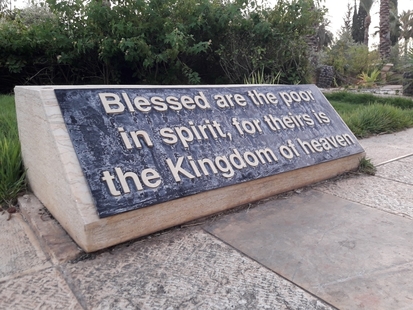
first beatitude

Today’s Gospel acclamation. We can be rich or poor in our earthly life but we are called to be poor in spirit – to surrender and depend entirely on God.

28th Sunday of Ordinary Time

Marry, but close the back door

07 Sunday Oct 2018

Posted by tonysee in The Next Mile

≈ 2 Comments

I once lend a listening ear to a good friend contemplating divorcing her husband. There had been endless disagreements. Often it’s in arguments over trivial matters that suggest a marriage unworkable. I shared that divorce is like a back door out of a room. It should never have been there.

When a married couple enter into an argument, the only way they must come out of it is through the door of resolution. Divorce must never be an option in a couple’s mind. When it is, it becomes like a back door out of the room. We won’t use it immediately but we know it is there. Just knowing it is there is enough for it to gradually play on our minds. When arguments grow, there will be a growing temptation to use the back door rather than the door of resolution.

When a couple sit down to discuss their disagreements knowing fully well that divorce is out of question, they will at least begin in agreement that a solution must be found. This too plays on the mind. It will be tough but the absence of the back door will mean that there will be an accommodative spirit of compromise.

“From the beginning of creation God made them male and female. This is why a man must leave father and mother, and the two become one body”. (today’s Gospel)

When marital vows are exchanged, they are, in truth, for life. There are no ‘buts’ but a lifelong commitment of two people becoming one. Holy matrimony is this journey. Two can become one simply by accommodating each other. Two persons are incredibly different but two persons can incredibly be one over time when they want to understand and accept each other. And these begin in small, seemingly trivial matters. When they do this, they grow into one another, gradually more united, eventually two becoming one. Marriages last because true love accommodates.

The institution of marriage has been greatly devalued. Divorces have been on the rise especially in affluent societies. One of the reasons for this is that self-importance has grown like an epidemic. Two becoming one requires self-giving not self-importance. Marriages should never be for self-benefit. Otherwise, the back door will always beckon.

“They are no longer two, therefore, but one body. So then, what God has united, man must not divide”. (today’s Gospel)

This is God’s law for all marriages. Simply put, divorce is not an option. As we grow in our self-importance, we also grow in our bravery to question the rights of God to interfere in our personal life. God does not rule like a human leader for the sake of authority but his laws are made for the love of us. God is infinitely wiser than me and you. Without his laws to govern our self-importance, man will head towards division, our human person towards a major meltdown. This law protects us, not God.

Christ is the bridegroom and we, his church, the bride. He gave himself totally to us.

Constant self-giving erodes self-importance. It gives life to a marriage. Marital bliss is not a fantasy but a growing fruit as two become one. Having a back door to get out will doom it to failure. More than 10 years on after my friend shut the back door, she is enjoying marital bliss.

Marriage

‘But from the beginning of creation God made them male and female. This is why a man must leave father and mother, and the two become one body. They are no longer two, therefore, but one body. So then, what God has united, man must not divide.’

27th Sunday in Ordinary Time

The Better Argument

23 Sunday Sep 2018

Posted by tonysee in The Next Mile

≈ Leave a comment

How much do we really compete with one another every day? How conscious are we of our actions in trying to be better than the other person? Indeed there are big, tangible rewards for being better. This world somewhat out of necessity adopted such a grading system. But is there a better way to live?

“They had been arguing which of them was the greatest. So he said, ‘If anyone wants to be first, he must make himself last of all and servant of all.’” (Today’s Gospel)

The disciples were arguing with words but no doubt would have been justifying their argument by quoting their deeds, capacities and abilities. Today have we become more hypocritical in trying to be the better? Do we plot more in our hearts and use words to camouflage our true intention?

“Where do these wars and battles between yourselves first start? Isn’t it precisely in the desires fighting inside your own selves? You want something and you haven’t got it; so you are prepared to kill.” (Today’s second reading)

We are called to make our ‘self’ last. This does not mean that we hypocritically engineer ourselves to be last through a polite refusal to perform according to our capabilities. Rather it calls for us to wholeheartedly volunteer ourselves to care first for the people around. Every person is blessed uniquely with a set of gifts and talents. By this world’s standard of measurement the obvious inequality is unfair to begin with.

But our Creator justifies this with a plan and purpose for each person. This ‘unfairness’ according to our grading system will be equalized through an honest use of the gifts we are blessed with. The honesty of this use includes the sharing of its rewards. The Creator planned for a communal world. We begin life with seeds of unique capabilities. We plant them, work with maximum effort nurturing them and as we grow into the world we harvest its rewards and share them with this communal world.

Through our unique gifts, some will end up with material wealth, status, influence and power. Up to this point these are meant to happen. It is what we do with these harvests that causes arguments. Our gifts given and used are converted into tools of influence. With wealth and status we can contribute and build the communal world that God created. It is at this point that “fighting inside your own selves” begin. Our desire to want to be first actually break both systems down.

“Wherever you find jealousy and ambition, you find disharmony, and wicked things of every kind being done; whereas the wisdom that comes down from above is essentially something pure; it also makes for peace, and is kindly and considerate; it is full of compassion and shows itself by doing good; nor is there any trace of partiality or hypocrisy in it.” (Second Reading)

At the end it is about which grading system we choose to believe in: a wise world with God or a world living without his purpose for us. Long ago this choice was put to a bet between Elijah and the Baal prophets. God won, so it’s better to be last.

Elijah

At Muhraka: Elijah had a bet with the Baal prophets: God as He is or the god of worldly desires

25th Sunday Ordinary Time

Mathematics of Faith

16 Sunday Sep 2018

Posted by tonysee in The Next Mile

≈ 1 Comment

We sometimes live in a mathematical world of probabilities and calculations. We juggle time, and place it like an investment for a better gain. We throw ‘good works’ into the equation to seek for a better balanced life. We select people we want to associate with, often the factor of choice being how much beneficial influence they will have on our lives. We sub consciously calculate the probability of some returns according to who we help and what we need to do.

We will probably be more ‘willing’ to do something for the boss at work, and perhaps hesitate towards helping someone “who is in need of clothes and has not enough to live on” (second reading). Everyone will be somewhat guilty of this behavior but in the law of human nature set in the realities of this world, this is unavoidable because of our human instinct to survive. But this is purely our human self.

Faith invites us to look at our spiritual self. Faith states that life is eternal. Eternal life is the biggest reward of human life and this beneficial reward can either be won or lost. Faith states that human life is a sub set of spiritual life. Our logic must embrace both. In every permutation to make our human life better, the factor of a spiritual life must be present. And here is the formula.

“If anyone wants to be a follower of mine, let him renounce himself and take up his cross and follow me. For anyone who wants to save his life will lose it; but anyone who loses his life for my sake, and for the sake of the gospel, will save it.” (Today’s Gospel)

We need to re-calibrate. This is a leap into faith: we need to re-assess the cost to ‘self’ in all that we do. In the pureness of this faith formula, ‘self’ has to be set at ‘zero worth’ for self to eventually be worth the big reward of eternal life. Renounce ‘self’ and substitute with “take up the cross”.

The example of this faith formula has already been given. He is the Christ who gave everything of him ‘self’ as an act of pure love for the other. He emptied him ‘self’ to the point of accepting death, even death on a cross. Christ demonstrated the method to live our human life with faith. Faith must be evidenced by good works. “Faith is like that: if good works do not go with it, it is quite dead.” (Second reading)

Pure good works, in simple description, is going the extra mile for the other person. Good works are done without calculation and expectation of gains. They are not done out of obligations. We give without counting costs. In our mind, there is no ulterior motive. In the pureness of good works, we simply do because it needs doing. In the other person we recognize human life that need preserving for eternity. Faith is a gift to give to preserve life. And this faith is only tangible and visible through good works.

In this extra mile we will experience the reality of Christ in the realities of our human world. Good works is the common denominator in the mathematics of faith. It equalizes our human instincts to survive by fueling growth in our spiritual life. Good works is intentional discipleship “to be a follower of mine”.

Extra Mile Rayong

Going the extra mile for the other person. Good works are done without calculation and expectation of gains. They are not done out of obligations. We give without counting costs.

24th Sunday in Ordinary Time

The 3 wise monkeys

09 Sunday Sep 2018

Posted by tonysee in The Next Mile

≈ 1 Comment

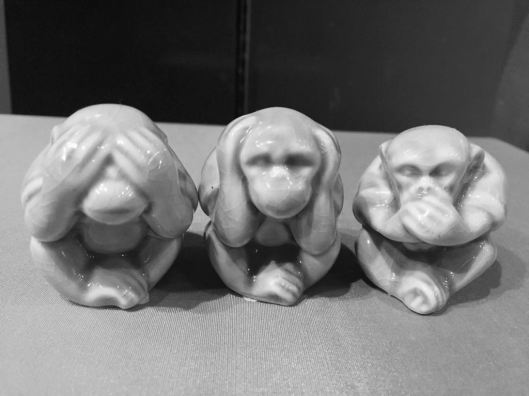
“See no evil, hear no evil and speak no evil”. In tradition, these 3 wise monkeys mean to tell us to be of good mind, speech and action. Interestingly over time it became ‘turning a blind eye’ to the action of others doing things that were not quite right. Well, our thinking and values are further evolving, actually quicker in this rich technological age. But as people, have we become richer or poorer?

Lifestyles today gravitate a lot towards ‘self’. More and more we are exercising ‘personal rights’. ‘Self’ is winning the race to come first before community. When we look at the 3 monkeys, they too seem to have lost some wisdom. Maybe today’s monkeys are saying, “I don’t want to know, I don’t want to listen and I really don’t care”.

In the race to become rich according to the world, we sometimes embrace a culture of selfishness and allow the hands of the world to cover our eyes, ears and mouth to the promptings of a God who seem to be interfering with our desires with his conservative and traditional ways. We are richer today in self-dependence so much so that we think poorer to leave God behind.

Today’s second reading speaks of the rich “beautifully dressed and with a gold finger on” and the poor “in shabby clothes”. When we read it carefully, it is not a damning verdict on the materially rich but a warning against the discrimination of the poor. This particular rich man did not leave God behind otherwise he wouldn’t be appearing at the synagogue.

The poverty of the poor is obvious. They are shabby according to the world, materially poor in money and possessions. We must not be deceived into judgement and to discriminate against the poor. These days, we must also carefully watch our righteous self not to discriminate against the materially rich. For poverty according to God is the poverty of the spirit.

Beneath every rich person’s beautiful clothing are also pockets of poverty. Every person, rich and poor alike, struggle with the challenges of daily life. We will experience poverty in love, happiness, fulfilment; poverty in losses, relationships and health. This is inevitable in our human world. It is in these pockets of poverty where God come to call. Those “who are poor according to the world that God chose, to be rich in faith and to be the heirs to the kingdom which he promised to those who love him”.

It is through challenges in life where we become richer in faith. We are called to go into the world of spiritual poverty to unclasp the hands of the material world that cover our eyes, ears and mouth taking away our dependence on God. We must not be afraid of losing what we have but to use whatever material richness to address this poverty of the spirit. When we race only for ‘self’, there will be no winners, rich or poor. We must not choose the way of the modern day monkey, “I don’t want to see, listen, do or care”.

“‘Courage! Do not be afraid. Look, your God is coming, he is coming to save you.’ Then the eyes of the blind shall be opened, the ears of the deaf unsealed, then the lame shall leap like a deer and the tongues of the dumb sing for joy”.

As people we must become richer. Christ want us to have this richness to live life through being poor in spirit. “Ephphatha, be opened”.

3 wise monkeys

23rd Sunday of Ordinary Time

← Older posts
Newer posts →

Recent Posts

  • Total giving
  • Mission involves moving out
  • Re- manifestation
  • Resolution to return to faith life
  • Christmas: Bringing the Gift of Change

Categories

  • The Next Mile
  • Uncategorized

Recent Comments

John Bennett's avatarJohn Bennett on Encounter
Fr. Aangelo's avatarFr. Aangelo on Advent:  Faith – Prepare a way…
Katy's avatarKaty on Encounter
Anthony Wong's avatarAnthony Wong on You MUST rejoice

Archives

Blog at WordPress.com.

  • Subscribe Subscribed
    • always returning
    • Join 69 other subscribers
    • Already have a WordPress.com account? Log in now.
    • always returning
    • Subscribe Subscribed
    • Sign up
    • Log in
    • Report this content
    • View site in Reader
    • Manage subscriptions
    • Collapse this bar
 

Loading Comments...